Ai.Com, Founded by Kris Marszalek, Unveils Upcoming AI Agents
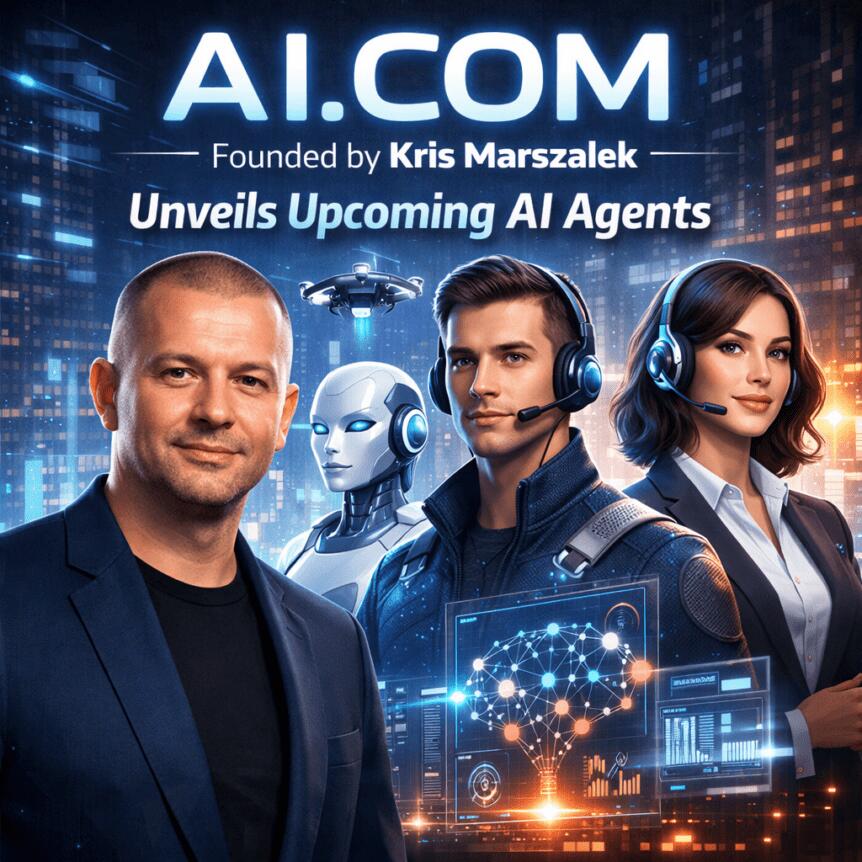 AI-driven agents are moving from the fringes of crypto discourse toward practical onboarding features, with ai.com announcing an autonomous AI agent aimed at retail users. The platform, led by Kris Marszalek, co-founder of Crypto.com, said the agentic AI would handle a range of tasks—from stock trading in traditional markets to workflow automation and even mundane [...]
AI-driven agents are moving from the fringes of crypto discourse toward practical onboarding features, with ai.com announcing an autonomous AI agent aimed at retail users. The platform, led by Kris Marszalek, co-founder of Crypto.com, said the agentic AI would handle a range of tasks—from stock trading in traditional markets to workflow automation and even mundane calendar updates or adjustments to social profiles. The announcement emphasizes privacy controls: user data is segregated and encrypted with keys unique to each user, and the agent operates within restrictions defined by the user. If proven reliable, the technology could lower the barriers for newcomers navigating blockchain networks, token standards, and on-chain actions that historically demanded technical know-how.
Key takeaways
The autonomous AI agent targets retail users, promising to automate tasks that span financial activities and everyday digital management, including calendar updates and social-profile changes.
Data protection is central: per-user encryption keys and user-defined restrictions aim to limit what the agent can do on behalf of individuals.
Interest in agentic AI is rising among enterprises, with about 23% of respondents in a McKinsey survey indicating their organizations are expanding the use of AI agents.
Proponents argue AI agents could simplify crypto onboarding by choosing optimal execution paths and streamlining stablecoin usage, potentially reducing friction for newcomers.
Industry observers see opportunity to automate wallet management and arbitrage under autonomous guidance, though security and governance questions remain.
Sentiment: Neutral
Market context: The emergence of autonomous AI agents comes as crypto markets grapple with onboarding friction, evolving user interfaces, and a push toward more accessible wallet and token management. The development aligns with broader enterprise AI adoption trends and a growing interest in agent-based automation within digital economies.
Why it matters
The promise of agentic AI in crypto hinges on lowering the entry barrier for non-technical users. By abstracting away the decision-making and operational steps involved in sending funds, selecting networks, or interacting with tokens, these agents could make it easier for newcomers to participate in decentralized finance and Web3 ecosystems without mastering complex interfaces or learning every token standard. In theory, an autonomous agent could scan networks for cost-effective routes, select faster payment rails, and automate repetitive tasks that currently require manual intervention. This shift could broaden the user base beyond hobbyists and early adopters to a more mainstream audience curious about crypto but deterred by technical hurdles.
The technology also carries implications for portfolio management and yield opportunities. Proponents point to the potential for agents to optimize arbitrage or identify yield-bearing opportunities across token standards, all while respecting predefined risk limits. If AI can consistently identify cheaper and faster execution paths and simplify stablecoin usage, it might encourage more users to explore diversified holdings, including tokens and assets that require more sophisticated transaction flows. However, the same capabilities that enable efficiency also raise concerns about misconfigurations, overreach, and the potential for exploited permissions if safeguards fail.
From a builder’s perspective, the introduction of autonomous agents could spur new abstractions around key management and secure signing. The emphasis on encryption and per-user keys signals a governance-driven approach to reduce cross-account risk, yet it also shifts responsibility for setting appropriate restrictions and monitoring agent behavior onto users. Security design, transparency about agent actions, and robust audit trails will become essential as these tools scale from pilot programs to broader consumer use. The balance between convenience and control will shape how quickly such technology gains trust and traction in crypto markets.
What to watch next
Product availability and rollout timing: when will retail users gain access to the autonomous AI agent and what onboarding steps will be required?
Security features and governance: how granular will user restrictions be, and what happens if an agent attempts an action outside approved scopes?
Regulatory clarity: how will regulators respond to autonomous agents handling on-chain and off-chain tasks, particularly around custody and execution?
Partnerships and integrations: will the agent integrate with major wallets, exchanges, or DeFi protocols to broaden supported actions?
Adoption metrics: early user feedback, engagement levels, and the impact on friction-to-activation for new crypto participants.
Sources & verification
ai.com announcement of autonomous AI agents for retail consumers via PR Newswire.
“What is agentic AI and how does it work” explainer linked in the article.
McKinsey & Company, The State of AI — findings indicating that about 23% of surveyed organizations are expanding AI agent usage.
AI agents and blockchain redefine digital economy — Cointelegraph piece referenced for context on agentic AI in crypto.
Crypto dev launches website for agentic AI to ‘rent a human’ — Cointelegraph reference for related developments.
Autonomous AI agents and onboarding: What it changes
The launch by ai.com signals a broader push to bring autonomous, decision-support tooling into crypto and Web3, moving beyond purely trading signals toward hands-off management capabilities. By positioning the agent as a general-purpose assistant capable of executing a spectrum of tasks—ranging from portfolio actions to routine digital housekeeping—the platform seeks to address the most persistent user-experience bottlenecks in crypto adoption: the misalignment between user intent and technical execution. The core proposition is simple in concept: let an autonomous agent navigate the complexities of networks, tokens, and wallets so that a typical user can focus on goals rather than steps.
On the execution front, proponents argue that agentic AI can select the most cost-efficient routes for transfers, optimize timing to benefit from price movements, and streamline interactions with stablecoins—reducing the cognitive load that typically accompanies crypto transactions. The promise extends to wallet management, where agents could monitor balances, rebalance portfolios, and even implement predefined risk controls without requiring manual intervention. This, in turn, could enable users to maintain exposure to a broader array of assets and token standards than they would manage manually, potentially increasing diversification while maintaining discipline over risk tolerance.
Security and privacy are central to the design. The announcement highlights segregated user data and encryption keys unique to each user, coupled with user-defined restrictions that govern what the agent can and cannot do. In practice, this means that the agent operates within a sandbox of permissions, reducing the likelihood that a single misstep could expose sensitive information or trigger unintended transfers. Yet the guardrails themselves become a new layer of governance: users must understand and configure the constraints that govern automated actions, and providers must offer transparent auditing to build lasting trust as these agents scale to millions of individuals.
From a market perspective, the idea of autonomous agents aligns with longer-term trends toward more accessible crypto experiences. The McKinsey statistic cited in the related discourse—about a quarter of organizations expanding AI agent use—reflects a broader appetite for automation across sectors. The convergence of AI with blockchain could unlock efficiencies that help onboarding and ongoing participation feel less daunting. Still, the trajectory depends on how convincingly these agents can demonstrate reliability, maintain security standards, and adapt to evolving regulatory expectations. The conversation is shifting from theoretical potential to measurable outcomes: user retention, reduced churn, and tangible reductions in friction points at critical milestones such as onboarding, funding a wallet, and executing trades.
Experts indicate that the most meaningful impact may emerge not from replacing human oversight entirely but from augmenting it. As one advocate noted, “When AI is integrated, all of the complexity in this space will be gone,” while emphasizing the capacity to manage more diverse token standards within a single interface. The vision is compelling: users could hold larger portfolios spanning different networks, with automation shouldering the operational burden while preserving user intent and control. In practice, this requires robust risk controls, clear visibility into agent actions, and defenses against errors or exploits. If these conditions are met, autonomous AI agents could become a mainstream feature of crypto wallets and platforms, accelerating both participation and sophistication among a broader user base.
Ultimately, the trajectory of autonomous agents will hinge on how well they balance convenience with accountability. They promise to unlock new forms of participation—a more fluid onboarding experience, the ability to react quickly to market opportunities, and a streamlined workflow for non-technical users. At the same time, they demand rigorous security, transparent governance, and a clear regulatory lens to address potential misuse. The coming months will reveal whether the initial demonstrations translate into a reliable product that can coexist with established trading and custody practices, or whether stakeholders will demand stricter standards before mass adoption takes hold.
This article was originally published as Ai.Com, Founded by Kris Marszalek, Unveils Upcoming AI Agents on Crypto Breaking News – your trusted source for crypto news, Bitcoin news, and blockchain updates.
About the Author


