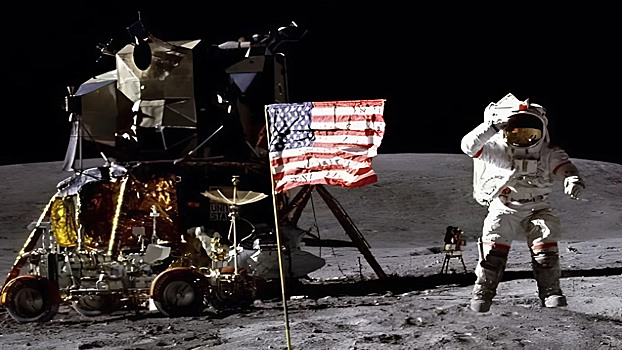
The start of the space race in the mid-twentieth century became an arena for the greatest technological competition between the USA and the USSR. The culmination of this confrontation was the Apollo 11 mission in July 1969, when humanity first set foot on the surface of another celestial body. This event not only changed the course of history but also spawned persistent conspiracy theories claiming the landing was a Hollywood hoax filmed on a set. Such doubts persist to this day. Nevertheless, there are facts that undeniably prove the inconsistency of such assumptions. Americans on the Moon: A Grand Deception of Reality? © NASA Lunar Soil Samples 382 kilograms of rocks and lunar dust (regolith) were brought to Earth by six successful Apollo missions. The composition of these samples differs radically from any terrestrial substrate. The collected rocks were distributed among institutes and research centers across the planet: over half a century, NASA has issued over 50,000 unique samples to more than 500 scientists from various countries. © NASA Astronaut Harrison Schmitt collecting lunar soil samples. Furthermore, the lunar soil contains the helium-3 isotope – an element rare on Earth, which accumulates on the Moon under the influence of the solar wind. These findings, confirmed by numerous laboratories and publications, make the fabrication of rocks with such a composition extremely improbable under 1960s conditions. The Four Closest Planets to Earth Where Life May Exist [This is a heading from the original text, not directly related to the following content] Laser Ranging Retroreflectors (LRRR) Passive instruments—corner reflectors installed by the crews of Apollo 11, Apollo 14, and Apollo 15—are located on the Moon’s surface. These devices are sets of mirrors capable of reflecting a laser beam exactly in the direction from which it came. The McDonald Observatory in Texas and the Pierre Simon Laplace Observatory in France still regularly use these reflectors as part of the Lunar Laser Ranging (LLR) program to measure the distance between the Earth and the Moon with centimeter accuracy. © Wikipedia Apollo 11 corner reflector. Modern Images from the LRO Probe Since 2009, the Lunar Reconnaissance Orbiter (LRO) probe, equipped with high-resolution LROC cameras, has been operating in lunar orbit. The craft, launched by NASA in the 21st century, provides independent verification of the Apollo landing sites. The images it captures, with a resolution of about 50 cm per pixel, clearly show all six landing sites: the remaining descent stages of the modules, scientific equipment, lunar rovers, and even the tracks left by the astronauts and rover wheels in the regolith are visible. © Wikipedia These images, published in the public domain, are available for analysis by scientists worldwide and serve as direct confirmation of the American expeditions’ presence on the lunar surface. Independent Tracking of Space Signals During the Apollo missions, the transmission of information and telemetry was received not only by NASA centers but also by a number of foreign stations belonging to the international tracking network, such as the Parkes Observatory in Australia and the British Jodrell Bank station, which recorded Apollo 11 telemetry in real time. The Soviet Union, possessing a developed tracking system and a political incentive, undoubtedly could have verified the authenticity of the mission. The absence of an official rebuttal, including in Soviet publications like the Great Soviet Encyclopedia, and the acknowledgment of the American program’s success are among the most compelling arguments against the forgery theory. Left Behind Scientific Equipment ALSEP At each of the six landing sites, the astronauts left Apollo Lunar Surface Experiments Package (ALSEP) complexes. These autonomous stations were powered by radioisotope thermoelectric generators and transmitted scientific data to Earth for many years. © Wikipedia Part of the ALSEP instruments left during the Apollo 16 flight. ALSEP included various instruments, primarily seismometers, which recorded “moonquakes,” meteorite impacts, and artificial jolts from the impact of jettisoned rocket stages. The seismic data obtained revealed a unique structure of the lunar crust, completely dissimilar to Earth’s. For example, signals from impacts on the Moon resonated longer, like a bell, due to the dryness and hardness of the regolith. Clarifying the Photo Documentation Conspiracy theories often appeal to “strange” visual effects in the pictures: a waving flag, non-parallel shadows, and the absence of stars. All these claims have clear physical explanations: Flag. The US national flag looked “waving” not because of wind, which is absent in a vacuum, but because it was fixed on a horizontal, extendable crossbar to give it shape. The astronauts did not fully extend this crossbar, which created the ripple effect. Shadows. Shadows appear non-parallel due to the uneven lunar landscape and the peculiarities of perspective when using wide-angle lenses. On the Moon, as on Earth in bright sunlight, there is only one light source—the Sun. Stars. Stars are not visible in the photographs because a very fast shutter speed was used to capture the brightly sunlit spacesuit and the light-colored lunar landscape. With this exposure setting, the faint light of the stars simply did not have time to be captured on the film. © NASA Buzz Aldrin standing near the US flag on the Moon. The Huge Number of Participants The Apollo program was not just one mission; it was a decade-long program involving over 400,000 scientists, engineers, technicians, contractors, and administrative workers. The secrecy required to keep such a massive number of participants, including contractors, disgruntled former employees, and political opponents, completely silent for over 50 years is logistically and mathematically unfeasible. The probability that someone from this gigantic number of people would spill the beans, sell information, or come forward with a revelation would have been immeasurably high. Successfully concealing a secret of such magnitude would, in essence, have been a more difficult and costly task than the space expedition itself. Objects on the Lunar Surface During the Apollo missions, some parts of the Saturn V launch vehicle and jettisoned sections of the lunar modules were intentionally directed toward the Moon. For example, the third stage (S-IVB) of several missions was disposed of in such a way as to crash into the surface. The purpose of these controlled crashes was to induce artificial seismic vibrations. Data from these impacts were recorded by the previously installed ALSEP seismometers. Analysis of the trajectories, impact times, and the seismic data obtained clearly shows that these massive, heavy objects followed ballistics corresponding to the Moon’s gravitational field and reached the very surface visited by the astronauts. Conclusion There is physical evidence, open experiments available for verification by anyone interested, modern images from independent probes, and testimony from outside observers, including geopolitical rivals. All these facts are supplemented by the logical impossibility of concealing a secret of this scope and the scientific data collected on the surface.
About the Author


