Tokenized RWAs Accelerate as CoinShares Sees DeFi Resurgence
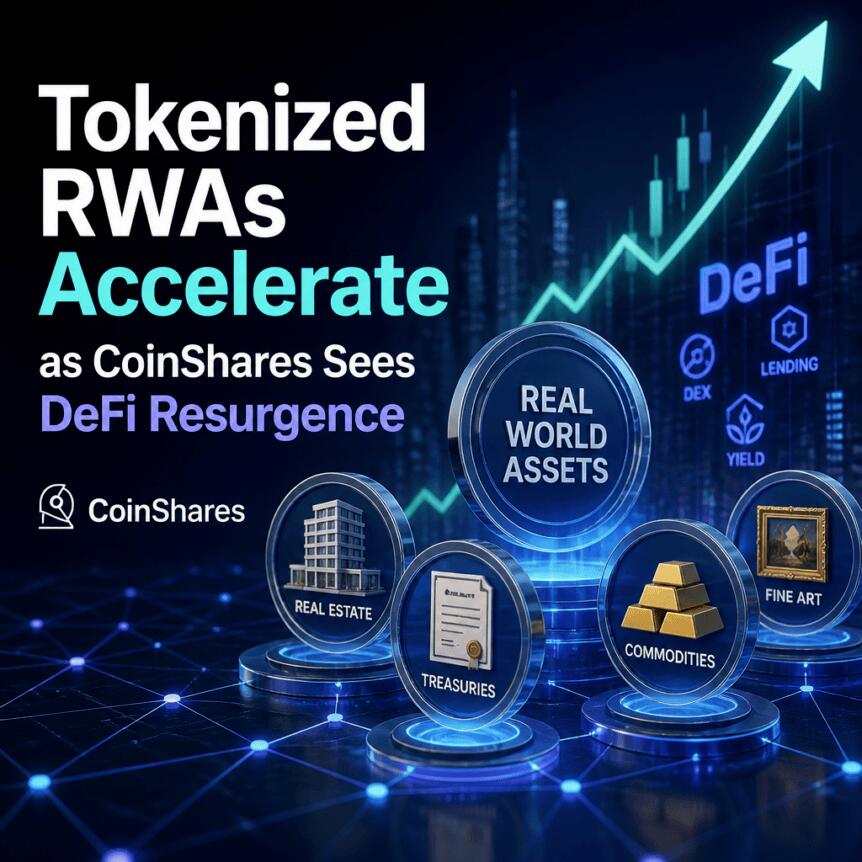 Real-world assets (RWAs) are moving from experiment to utility, with tokenized versions of traditional investments increasingly showing up as collateral, yield sources, and trading instruments on-chain. According to a joint CoinShares and Token Terminal report published Thursday, RWA deposits across decentralized finance (DeFi) platforms more than tripled year over year to $7.4 billion in Q2 [...]
Real-world assets (RWAs) are moving from experiment to utility, with tokenized versions of traditional investments increasingly showing up as collateral, yield sources, and trading instruments on-chain.
According to a joint CoinShares and Token Terminal report published Thursday, RWA deposits across decentralized finance (DeFi) platforms more than tripled year over year to $7.4 billion in Q2 2026. Over the same period, total DeFi deposits declined by about 15%, underscoring a widening split between broad DeFi activity and RWA-specific demand.
Key takeaways
RWA deposits surged to $7.4B in Q2 2026, more than tripling year over year, even as overall DeFi deposits fell ~15%.
Yield-bearing stablecoins and tokenized Treasuries are the largest RWA categories used as on-chain collateral and liquidity.
RWA spot trading volumes rose ~220% year over year while overall DEX volumes fell about 70%.
RWA derivatives activity is expanding, with RWA-focused perpetual futures seeing sharp growth since launch on tradeXYZ.
RWA demand is pulling away from broader DeFi trends
The report’s most striking datapoint is the contrast between RWA growth and the cooling of mainstream DeFi. CoinShares CEO Jean-Marie Mognetti framed the divergence as evidence that RWA demand is not solely dependent on wider market conditions.
“When an asset class grows through a downturn in its host ecosystem, demand is being driven by financial utility, not by market cycles,” Mognetti said in connection with the findings.
CoinShares and Token Terminal also characterize the shift as part of a broader transition: RWAs are increasingly being used for collateral, yield strategies, and trading exposure across onchain markets—rather than merely being issued and held.
Yield-bearing stablecoins and tokenized Treasuries lead deployments
Across DeFi platforms, the report identifies yield-bearing stablecoins and tokenized Treasury products as the dominant RWA asset types in active use.
In Q2, Sky Protocol’s sUSDS was noted as the category leader. The token provides exposure to a yield-generating version of Sky Protocol’s USDS stablecoin, reflecting a growing pattern: traders and borrowers are increasingly looking for stable or cash-like instruments that can also generate returns.
The report also points to tokenized Treasury funds as a major source of on-chain collateral. BlackRock’s USD Institutional Digital Liquidity Fund (BUIDL) is specifically mentioned as part of this broader category, suggesting that institutional-grade cash management structures are finding a role inside decentralized lending and borrowing.
CoinShares and Token Terminal further state that yields across RWA products currently span roughly 3.2% to 5.5%. The report attributes the lower end of that range largely to Treasury-linked products, while higher-yield strategies are associated with additional risks. For participants, the practical takeaway is that “RWA yield” is not a single product feature—it is an outcome shaped by instrument type and underlying risk.
Gold and yield-bearing dollars are driving RWA trading
Beyond deposits, the report highlights how RWAs are shaping trading activity on decentralized exchanges. Gold-backed tokens and yield-bearing dollar products accounted for a large share of RWA trading volumes.
CoinShares categorizes gold-backed stablecoins such as Tether Gold (XAUt) and Paxos Gold (PAXG) as tokenized gold products within its RWA framework. The report says these assets generated meaningful trading volume as investors rotated around gold price moves.
On the dollar side, yield-bearing stablecoin infrastructure such as Ethena’s sUSDe contributed to RWA spot activity. The underlying theme is consistent: tokenized real-world exposure is being used as both a return-bearing allocation and a tradable instrument, rather than only a “hold-to-exposure” product.
In terms of performance, the report notes that RWA spot trading volumes rose about 220% year over year despite a broader ~70% drop in overall DEX volumes. CoinShares and Token Terminal interpret the divergence as evidence that tokenized assets are increasingly operating as secondary-market instruments—allowing users to trade ownership and exposure over time, not just participate in primary issuance.
RWAs are reaching derivatives: from spot to leverage
The report also argues that RWAs are expanding into leveraged markets, particularly derivatives—where traders can take exposure without holding the underlying tokenized asset itself.
It notes that RWA perpetual futures trading has continued growing even as crypto-native derivatives overall have slowed. A key example cited is tradeXYZ, described as an RWA-focused perpetual futures platform built on Hyperliquid. The report states that trading volume on tradeXYZ has increased roughly 20 times since launch, with activity concentrating around commodities and major equity indexes, including the S&P 500 and Nasdaq-100, as well as technology stocks. The report also says open interest has continued rising.
For market participants, this matters because derivatives participation can change how RWAs are priced and hedged. If liquidity deepens in futures and perpetual products, the tokenized assets may become more integrated with broader trading and risk-management workflows—though the report does not provide further breakdowns on settlement mechanics or market risk.
What to watch next
With RWA deposits growing while overall DeFi deposits contract, the key question is whether this pattern continues as more yield-bearing stablecoins, tokenized Treasuries, and commodity-linked tokens expand across both spot and derivatives. Investors and builders should watch for further growth in RWA secondary liquidity, changes in risk profiles across yield strategies, and whether derivative platforms sustain their momentum beyond early traction.
This article was originally published as Tokenized RWAs Accelerate as CoinShares Sees DeFi Resurgence on Crypto Breaking News – your trusted source for crypto news, Bitcoin news, and blockchain updates.
About the Author


