US moves to seize $61M USDT linked to sanctioned Iranian oil sales
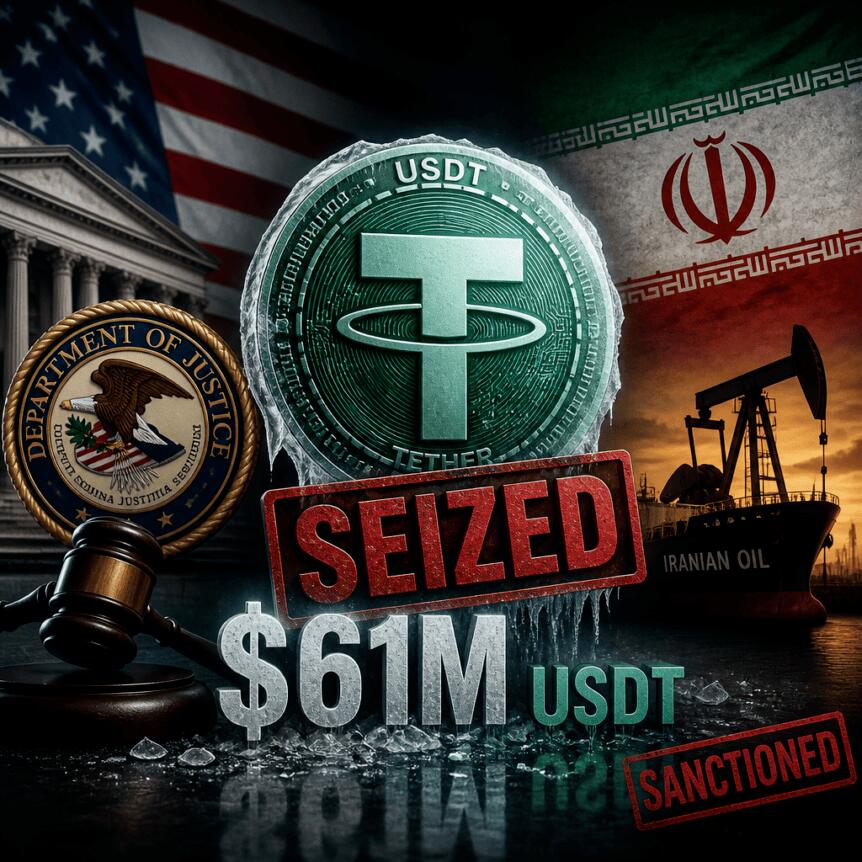 The U.S. Department of Justice is pursuing forfeiture of more than $61 million worth of Tether’s USDT, alleging the stablecoin proceeds were tied to black-market sales of sanctioned Iranian oil. The government’s civil forfeiture case contends that the crypto linked to these oil shipments was intended to support Iran’s government and military entities, including the [...]
The U.S. Department of Justice is pursuing forfeiture of more than $61 million worth of Tether’s USDT, alleging the stablecoin proceeds were tied to black-market sales of sanctioned Iranian oil. The government’s civil forfeiture case contends that the crypto linked to these oil shipments was intended to support Iran’s government and military entities, including the Islamic Revolutionary Guard Corps (IRGC).
According to the DOJ filing, a network associated with two Hong Kong-incorporated entities—Blessed Trust and Hexa Whale—used Binance accounts to move proceeds from oil sold to buyers in China. The DOJ says related blockchain activity involved more than $1.5 billion in transfers, including movements toward businesses allegedly connected to IRGC-linked financial channels, cryptocurrency addresses, and an Iranian exchange.
Key takeaways
The DOJ seeks forfeiture of about $61.19 million in USDT tied to alleged Iranian oil proceeds and support for IRGC-linked activities.
The complaint points to Binance accounts used to route funds, while Binance says it did not allow transactions with sanctioned individuals and is cooperating with authorities.
Tether states it froze roughly 61.19 million USDT across 10 Tron addresses in 2025 under a process tied to a seizure warrant.
The filing adds to expanding U.S. sanctions pressure on Iran’s ability to use digital assets for oil-related payments.
Energy-market disruptions in the Middle East, including attacks impacting Saudi infrastructure and shipping routes, have contributed to higher oil prices alongside the legal crackdown.
DOJ civil forfeiture targets USDT connected to Iranian oil
In its Monday allegation, the DOJ said Blessed Trust and Hexa Whale used Binance accounts to handle funds derived from oil sales to buyers in China. The filing describes an ecosystem of related addresses that, according to the government, received and distributed more than $1.5 billion. It further claims some transfers were directed to entities tied to IRGC-linked money-transfer services, as well as crypto addresses and an Iranian exchange.
The DOJ’s action is framed as civil forfeiture, meaning the government seeks a court order to obtain permanent ownership of the assets if it convinces the court in its favor. The filing also notes that the allegations have not been proven in court.
Binance disputes claims and points to cooperation
A Binance spokesperson told Cointelegraph that the exchange does not permit transactions with sanctioned individuals. The spokesperson also said Binance was continuing to cooperate with law enforcement, including by investigating, restricting, or freezing accounts where appropriate.
Importantly, Binance indicated that the case was not filed against the exchange and did not claim wrongdoing by Binance itself.
Tether freezes USDT; how the seizure process is described
The court complaint says Tether froze approximately 61.19 million USDT across 10 addresses on the Tron network in 2025. The filing states that a seizure warrant would allow the FBI to take custody of the assets by requiring Tether to destroy the frozen tokens and issue replacements of equal value for transfer to an FBI-controlled hardware wallet.
Cointelegraph reached out to Tether for comment but had not received a response by publication. The DOJ’s complaint also specifies that the U.S. would gain permanent ownership only through a final forfeiture judgment issued by the court.
The Tether freeze matters for market participants because stablecoins are often used to move value quickly across jurisdictions. When a large issuer freezes tokens associated with a law-enforcement request, it signals that authorities are focusing on stablecoin rails—not just on exchanges or trading accounts—when tracing alleged sanctions evasion.
Broader U.S. sanctions pressure on Iran’s crypto-linked oil payments
The forfeiture case comes as Washington escalates financial pressure on Tehran, including through sanctions approaches aimed at the digital asset ecosystem.
Earlier this year, the U.S. Treasury expanded its Iran sanctions framework to cover the country’s digital asset sector, enabling U.S. authorities to target foreign individuals and companies operating in or supporting that sector. In connection with that expansion, the Treasury alleged that UAE-based broker Ivan Obukhov processed more than $100 million in crypto payments since 2023 to facilitate Iranian oil sales for the IRGC’s Quds Force.
Read together, these steps suggest a widening enforcement posture: rather than focusing solely on traditional banking channels, U.S. authorities are explicitly targeting how crypto might be used to receive, convert, and move value for oil-related transactions linked to sanctioned actors.
Oil market turbulence runs alongside the enforcement push
Separately from the legal developments, the geopolitical backdrop is continuing to disrupt energy flows. The ongoing conflict between the U.S., Israel, and Iran—which began in February—has affected oil shipments across the Middle East and contributed to price volatility.
Reuters reported on Tuesday that Saudi Arabia’s East-West pipeline remained offline after Friday attacks that Riyadh blamed on Iran-backed fighters in Iraq. Reuters also cited additional missile and drone attacks by Iran-backed Houthi forces on Saudi Arabia on Monday.
Market data at the time of publication showed Brent crude trading at about $107.59 per barrel, up 1.81%, while U.S. West Texas Intermediate was around $103.35 per barrel, up 1.93%, according to figures cited by Business Insider Markets.
While the DOJ case is about alleged financial routing around sanctioned oil, the parallel oil-price rise underscores how sanctions enforcement and conflict-driven supply disruptions are converging in real time—potentially increasing incentives for actors to seek alternative payment methods when traditional channels face tighter constraints.
For readers tracking this story, the next key variable is procedural: whether the forfeiture court rules in the government’s favor, and how both the alleged network and the stablecoin issuer’s freeze mechanism play out during litigation. As U.S. sanctions expand further into the digital asset sector, additional cases could follow that test how stablecoin issuers, compliance teams, and exchanges respond to law-enforcement requests tied to sanctioned trade.
This article was originally published as US moves to seize $61M USDT linked to sanctioned Iranian oil sales on Crypto Breaking News – your trusted source for crypto news, Bitcoin news, and blockchain updates.
About the Author


