Zcash Surges 20% After Paradigm Founder Discloses ZEC Holding
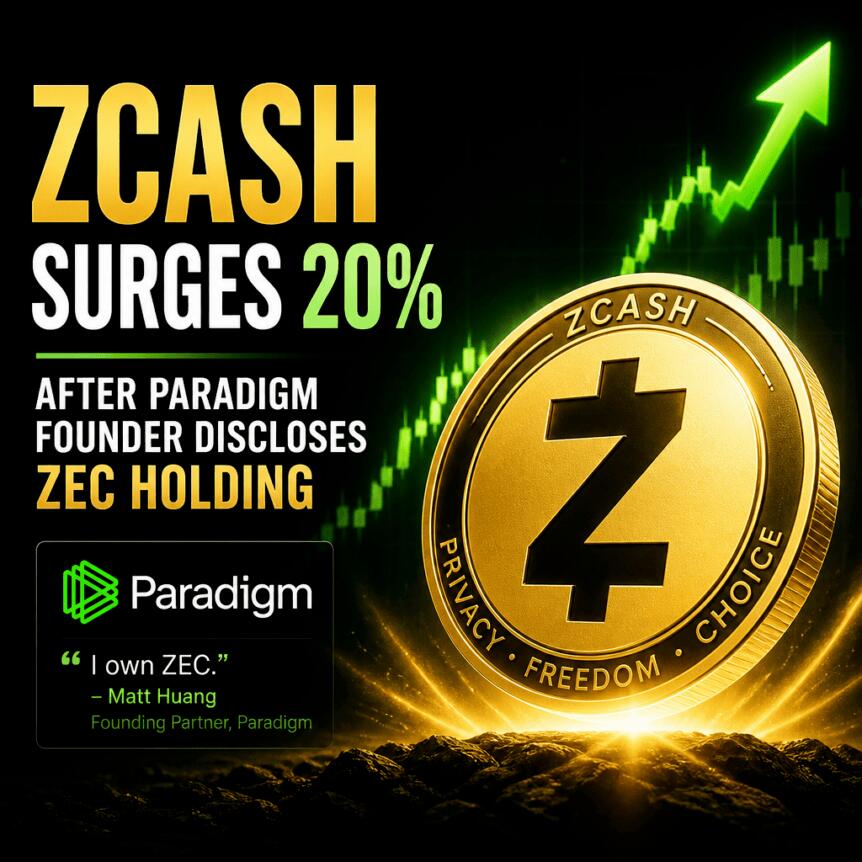 Zcash spiked sharply in the past day, with the privacy-focused cryptocurrency rising by roughly 20% over 24 hours after Paradigm co-founder Matt Huang disclosed that the firm made an unspecified purchase of ZEC. The move follows a broader month-long rally in which Zcash has vastly outpaced Bitcoin, according to CoinGecko price data. ZEC was trading [...]
Zcash spiked sharply in the past day, with the privacy-focused cryptocurrency rising by roughly 20% over 24 hours after Paradigm co-founder Matt Huang disclosed that the firm made an unspecified purchase of ZEC. The move follows a broader month-long rally in which Zcash has vastly outpaced Bitcoin, according to CoinGecko price data.
ZEC was trading around $1,338 at last look on Thursday, as the token built on gains that would bring its one-month increase to about 160%, compared with Bitcoin’s 18.2% over the same period, per CoinGecko.
Key takeaways
Zcash’s surge followed Matt Huang’s disclosure that Paradigm is both a ZODL investor and a ZEC token holder.
ZEC is up about 160% over 30 days, versus Bitcoin’s 18.2%, based on CoinGecko’s data.
Zcash’s architecture uses zero-knowledge proofs to support shielded transactions that hide addresses and transaction amounts.
Privacy coins have generally been outperforming the broader crypto market, with Glassnode data pointing to a large relative lift for the sector.
Paradigm ties spotlight Zcash’s on-chain privacy narrative
The catalyst for Zcash’s latest leg higher was a post by Matt Huang on Wednesday in which he revealed that Paradigm is an investor in the Zcash Open Development Lab (ZODL) and that the firm holds ZEC. The update reframed ZEC’s recent performance through the lens of long-term ecosystem support rather than short-term trading momentum.
Zcash is designed to enable shielded transactions—transfers where the sender and recipient addresses and the transaction amounts are concealed—using zero-knowledge proofs. Those privacy mechanics have been a consistent part of Zcash’s market identity, and the renewed attention around ZEC comes as traders look for assets that can stand apart from broader market direction.
In the same context, Huang characterized Zcash as a “private complement to Bitcoin” and emphasized the importance of sustained funding for development.
Funding the protocol: ZODL and Zcash’s developer model
Zcash’s institutional momentum is not entirely new. Paradigm’s involvement in the ecosystem was already public earlier this year, when ZODL announced a seed round of more than $25 million that included Paradigm, a16z crypto, Coinbase Ventures, and Winklevoss Capital.
Huang also pointed to Zcash’s inflation-funded developer fund, arguing that ongoing support matters as new threats emerge alongside advances in computing. He tied that view to the direction of cyber capabilities increasingly shaped by AI as well as the long-term implications of quantum computing.
Beyond funding, he highlighted governance questions. Huang said he supports combining Zcash coin voting with other forms of governance to reduce unpredictability for the network when ZEC is viewed as a monetary asset.
Macro backdrop: risk assets buoyed as rates rise ends a long pause
ZEC’s climb unfolded alongside strength in the broader crypto market. The timing also coincided with a Federal Reserve move that raised interest rates by 25 basis points to 3.75%-4%—the first increase since 2023—according to the Fed’s press release.
While tighter policy typically pressures speculative assets, crypto markets have often remained sensitive to how investors interpret the path of future rates rather than the immediate change. In this case, Zcash’s rally suggests that token-specific catalysts—especially those tied to institutional involvement and the privacy value proposition—can dominate even when macro conditions are mixed.
Privacy sector momentum: Zcash stands out within a wider trend
Zcash’s outperformance sits within a broader resurgence for privacy-related assets. Glassnode data shared on X indicated the privacy coin sector was 213% above its level at Bitcoin’s October 2025 peak. A separate “basket excluding ZEC” was up about 85% over the past year, per the same Glassnode post.
That comparison matters for traders trying to separate “industry beta” from asset-specific demand. If the broader privacy category is rising, ZEC benefits from sector tailwinds—yet its magnitude over the last month appears larger than the average move of peers, reinforcing the idea that Huang’s disclosure and Paradigm’s positioning added incremental attention and buying interest.
Zcash’s technical positioning also remains central to the story. Shielded transactions using zero-knowledge proofs are designed to make it difficult to trace addresses and amounts in normal transaction history, a key reason privacy assets repeatedly attract both supporters and regulatory scrutiny across markets.
Earlier coverage from Cointelegraph referenced Zcash’s Ironwood work and the protocol changes aimed at strengthening privacy and addressing proof-related concerns (including claims about “undetectable counterfeiting bugs”). While that background doesn’t directly explain Thursday’s jump, it provides context for why Zcash tends to attract investors who follow privacy engineering rather than purely speculative narratives.
Looking ahead, investors will likely focus on whether Huang’s disclosure leads to sustained inflows rather than a short-lived reaction, and whether ZEC’s momentum holds against the broader privacy basket. With the Fed setting a new tone after a long stretch of unchanged rates, traders will also be watching for how macro expectations interact with privacy-sector demand—especially if more institutional disclosures or ecosystem funding signals emerge from Zcash’s development partners.
This article was originally published as Zcash Surges 20% After Paradigm Founder Discloses ZEC Holding on Crypto Breaking News – your trusted source for crypto news, Bitcoin news, and blockchain updates.
About the Author


