Google Pushes Tools to Let Users Create Personalized AI Videos
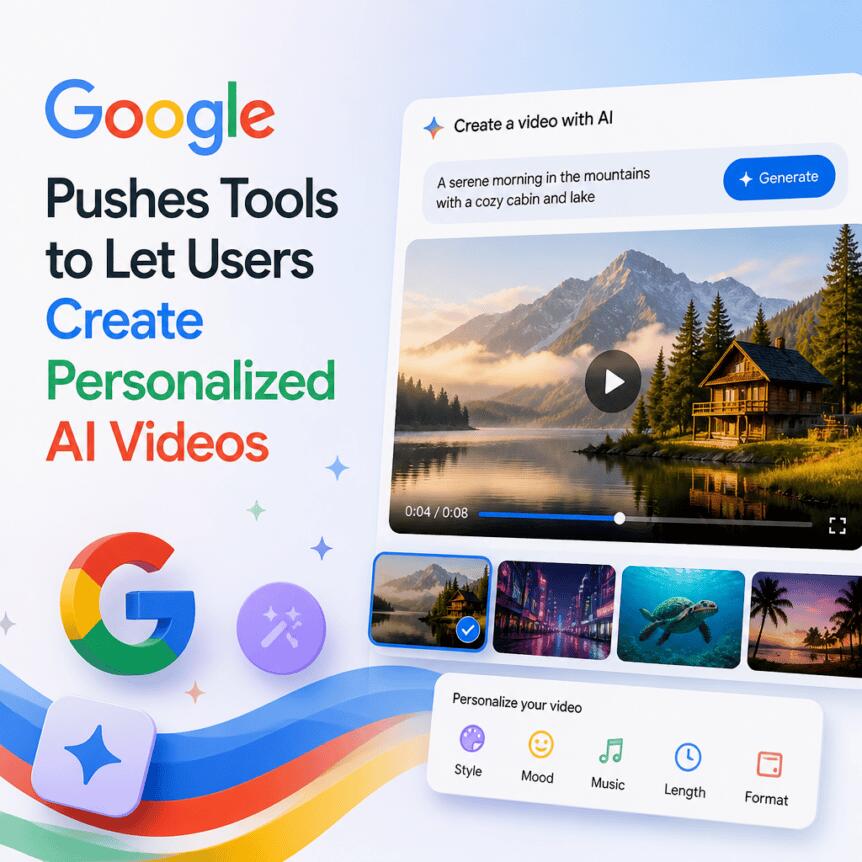 Google has filed a patent for an AI-driven “My Channel” system that would generate a personalized, user-specific stream of TV content. The approach goes beyond recommending shows: it envisions producing new AI-generated episodes that place the viewer at the center of the storyline, potentially using the person’s likeness and a synthetic voice for dialogue. The [...]

Google has filed a patent for an AI-driven “My Channel” system that would generate a personalized, user-specific stream of TV content. The approach goes beyond recommending shows: it envisions producing new AI-generated episodes that place the viewer at the center of the storyline, potentially using the person’s likeness and a synthetic voice for dialogue.
The filing, submitted May 13, 2025 and published by the US Patent and Trademark Office on Thursday, describes how the system could combine information about a user’s profile and viewing history with AI video generation. In at least one example, it even suggests using photos or videos of the viewer to create a digital representation and generate a tailored narrative aligned with the viewer’s preferred genres and top watched content.
Key takeaways
Google’s patent proposes generating an AI channel where the viewer plays the protagonist, using viewing history and demographic data to steer content.
The system describes using the user’s images or videos to create a digital likeness and employing a synthetic voice for in-character dialogue.
Google’s examples show narratives shaped by a user’s “top watches” and preferred genres, with the story itself customized per user.
The filing also outlines a path for inserting advertisements into the AI-generated output via an ad server.
While patents don’t guarantee real-world deployment, similar AI microdrama efforts already exist in parts of the market.
From recommendations to “you starring” content
Personalized content recommendations are now standard across streaming platforms, but Google’s “My Channel” patent sketches a more immersive shift: an AI model that produces video content customized for a specific viewer. According to the filing, the generated videos would incorporate characteristics based on a user profile and align with the style and format of a viewer’s top watches, while sticking to their preferred genres. The narrative would still be adjusted to the individual, effectively turning user data into story input rather than just a ranking signal.
One example prompt included in the application reads like a direct instruction to a video generation model: “Generate a customized video for a user where the user will play the protagonist.” In other words, the customization is meant to change who is inside the scene and what happens to them, not merely which series or genre appears next.
How Google describes using a viewer’s likeness and dialogue
The filing indicates the system could create a digital likeness from photos or videos of the viewer. It also describes generating a synthetic voice so the user’s character can speak within the generated content. That combination—face representation plus voice generation—would be central to making the AI channel feel like the viewer is truly “in” the program.
Another example in the application centers on recent viewing behavior. Google describes a user who watched a video about a cricket player connected to the Cricket World Cup. The patent suggests the generated video could incorporate tournament elements and the player’s recent performance, including scenarios where the viewer’s character might cheer for India from the stands or interact with the athlete.
For investors and builders, the technical implication is straightforward: personalizing content at this level requires more than choosing assets from a library. It requires conditioning an AI video generation pipeline on both behavioral signals (history and genre preferences) and identity material (images or video of the user, plus voice generation). That raises engineering complexity and heightens scrutiny around privacy and consent, even if the patent itself does not describe the operational safeguards in detail.
Advertising could be built into the generation pipeline
Google’s proposal also includes room for commercials. In one version described in the filing, when a viewer selects an AI-generated show, an ad server retrieves the video, inserts ads, and streams the resulting version to the viewer’s TV.
This matters because interactive or dynamic ad insertion tends to rely on predictable video structure. If AI-generated content is variable from user to user, ad integration becomes a systems-design challenge: the platform must place ads in a way that works with generated scenes and maintains viewer continuity. The patent’s approach suggests Google is considering the operational requirement early rather than treating ads as an afterthought.
Similar experiments show the idea is already taking shape
Patents may never reach market, but Google’s concept aligns with a broader momentum toward AI-authored entertainment, especially short-form formats.
In China, NBC News has reported on AI-powered filmmaking efforts that produce large volumes of one-minute “duanju” microdramas each day. The broader pattern—fast, automated generation of episodic content—also appears in Israel, where the Shortical streaming service (available in the US) reportedly produces fully AI-generated microdramas alongside conventional titles. According to the earlier coverage referenced in the patent story, Shortical even lets users audition their face for possible inclusion as characters in future AI-generated microseries.
While these examples do not prove Google’s patent will become a product, they underline a practical reality: parts of the market are already testing whether audiences will watch AI-generated narratives and whether user identity can be incorporated into synthetic characters. Google’s “My Channel” frames that experimentation as a system-level channel experience—an always-on pipeline that continuously produces content designed around a single viewer.
What to watch next
For readers, the key uncertainty is whether Google’s patent evolves into an implemented service and, if so, how it handles user consent, identity inputs, and ad delivery in a way that meets regulatory and audience expectations. The patent’s emphasis on personalization through likeness and voice sets a high bar for trust—and the next signals will likely come from any public product testing or policy disclosures that clarify how “protagonist mode” is operationalized.
This article was originally published as Google Pushes Tools to Let Users Create Personalized AI Videos on Crypto Breaking News – your trusted source for crypto news, Bitcoin news, and blockchain updates.
About the Author


