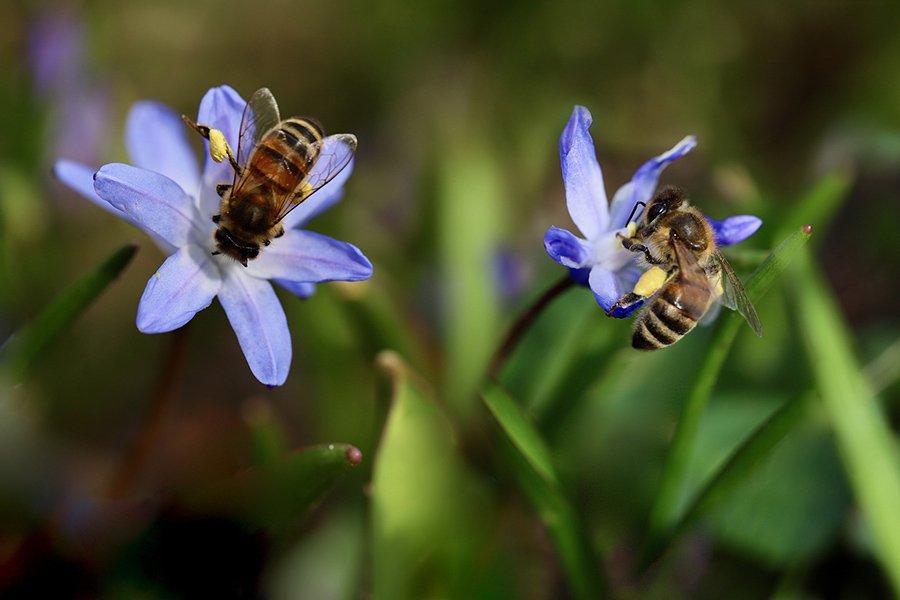
While striking colors often capture attention, another factor might hold equal sway in attracting bees. Intriguingly, bees sometimes observe the actions of their peers. If a flower already hosts visitors, other bees may follow suit.
Research conducted by Kyoto University and the National Organization for Agriculture and Food Research (NARO) indicates that this simple behavior can alter how flowers compete for pollinators. The findings are published in the journal Functional Ecology.
Studies suggest that a flower doesn’t always need the most vibrant hue to draw in bees. Securing early visitors can be just as crucial. Flowers employ various cues to attract pollinators. Bright colors, strong fragrances, and large petals help insects quickly locate sustenance.
For years, scientists presumed these signals gave flowers an edge in the competition for pollinators. Bees often exhibit inherent color preferences. Certain colors may appear more appealing to them, leading to more frequent visits to brightly colored blossoms.
However, bees also gather information from their surroundings. When a bee spots another bee feeding on nectar from a flower, that location can signal a reliable nectar source. This behavior helps bees avoid wasting time searching in unproductive spots.
Researchers from Kyoto University set out to investigate how social information might influence pollination. The team posed the question: do bees follow each other when selecting flowers?
“I started to wonder if the use of social information by pollinators could also influence the reproductive success of plants by shaping how they attract and retain pollinators,” stated co-author Lina G. Kawaguchi.
This notion opened up an interesting possibility. Even a less visually arresting flower could attract a multitude of bees if it successfully secured initial visitors.
To explore this, the researchers constructed a large flight arena designed to mimic a natural setting. The team utilized captive bumblebees, specifically Bombus ignitus, and established artificial flower patches of various colors.
Each patch contained numerous artificial flowers brimming with sweet nectar. Initially, bees frequented a white flower patch, which served as a good food source. Later, the scientists reduced the nectar in this area. Concurrently, two new flower patches with fresh nectar were introduced.
These new patches displayed different colors. In some experiments, the researchers also placed dead bees on one of the patches. These deceased bees acted as “early visitors,” prompting the live bees to believe others had already arrived. In the absence of early visitors, bees largely adhered to color preferences. Approximately 90 percent chose colors they naturally favored.
However, the results shifted when early visitors were introduced. Bees frequently migrated to the patch where other bees were already present, even if that flower’s color was less appealing.
In numerous instances, the presence of other bees nullified the advantage conferred by color. Occasionally, bees even favored a patch with early visitors over one featuring their preferred color. This behavior demonstrated that social information can significantly sway bees’ flower choices.
The researchers also observed changes in how bees explored the flowers. Bees were more inclined to approach and land on flowers that had been visited by bees earlier in the day. This behavior subsequently increased the chances of those flowers being chosen again later.
The study suggests that initial visitors can ignite a chain reaction. Once a few bees visit a flower patch, others notice and follow. Over time, this process can attract a substantial number of pollinators.
Scientists refer to this as the “imitation effect.” A flower becomes popular because other bees witness its use. This discovery reframes our understanding of flowers and pollinators. A plant with less striking coloration might still thrive if it blooms early and secures early bee visits.
Following the arrival of a few pollinators, others may join them. This effect can enhance a plant’s reproductive prospects, as pollinators aid in transferring pollen between blossoms.
“These findings suggest that the use of social information among pollinators can influence interspecific plant competition for pollinators in nature,” Kawaguchi remarked. “I believe this has important implications for future research on plant-pollinator interactions.”
In essence, bees don’t exclusively select flowers based on color or scent. Social behavior can also influence which plants successfully propagate. This particular study was conducted under controlled conditions. In natural environments, pollinators traverse greater distances and encounter a wider array of flower species.
Future research will involve tracking pollinators throughout their entire blooming period. Scientists aim to ascertain how early visits impact a plant’s success in real-world ecosystems.
The research may illuminate how pollinators shape flower evolution. Even a minor advantage, such as attracting the very first visitor, could alter which plants flourish in the wild.
About the Author