Tether Phases Out Gold-Backed aUSDT Derivatives Stablecoin
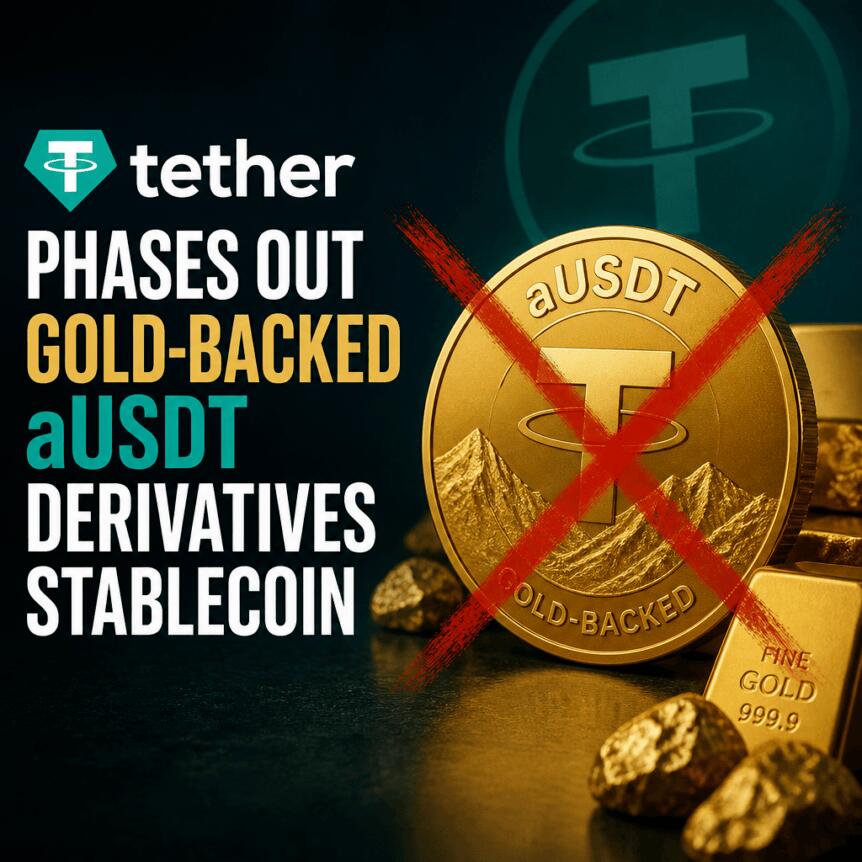 Tether is winding down Alloy by Tether and its gold-backed, overcollateralized aUSDT stablecoin after a short run of about two years. In a statement posted Wednesday, the stablecoin issuer said the move follows an internal review of user activity, market demand, and the company’s “broader priorities,” adding that it wants to concentrate resources where it [...]
Tether is winding down Alloy by Tether and its gold-backed, overcollateralized aUSDT stablecoin after a short run of about two years. In a statement posted Wednesday, the stablecoin issuer said the move follows an internal review of user activity, market demand, and the company’s “broader priorities,” adding that it wants to concentrate resources where it sees stronger demand and more enduring opportunities.
The shutdown is designed to be gradual. Tether will immediately stop new Alloy positions by preventing fresh aUSDT minting, and it is giving existing users a window to unwind their exposure by returning aUSDT and reclaiming the underlying XAUT by a cutoff date of Sept. 17.
Key takeaways
Alloy by Tether is being phased out after Tether says demand and strategic fit are weaker than for other products.
Tether is blocking new aUSDT minting immediately and sets Sept. 17 as the deadline for users to unwind their positions.
aUSDT was built as an overcollateralized derivative of XAUT, using Ethereum smart contracts.
XAUT remains active and is described by Tether as substantially larger in market capitalization than Alloy.
2025 also saw Tether discontinue CNHT (yuan) and EURT (euro) stablecoins, while it has continued to push tokenized real-world assets such as XAUT.
Why Alloy is shutting down now
Alloy by Tether was positioned as a bridge between gold exposure and dollar-like liquidity. According to Tether, it allows users to deposit XAUT—Tether’s gold-backed token—as collateral in order to mint or borrow against aUSDT. The design aims to keep the value of XAUT locked higher than the value of aUSDT issued, reflecting the overcollateralization model typical of collateralized synthetic assets.
In its announcement of “strategic changes,” Tether said it would focus on “stronger user demand, deeper liquidity and broader long-term market opportunity,” while continuing work across its broader ecosystem. The company explicitly pointed to XAUT—along with other core products—as areas it expects to be more central to its roadmap.
For users, the practical implication is that one of the most straightforward ways to convert gold token exposure into aUSDT liquidity will no longer be available. Traders and DeFi participants who used Alloy to avoid selling XAUT outright will now have to exit through Tether’s wind-down process rather than rolling positions forward.
How the wind-down works for aUSDT holders
Tether said the process will unfold in phases. The first phase begins immediately: users will not be able to open new positions and will be unable to mint additional aUSDT. Existing users will then have time to redeem their aUSDT and retrieve their XAUT.
Tether’s timeline gives users three months to return their aUSDT and reclaim their XAUT before the cut-off on Sept. 17. After that point, Alloy’s function as a collateral-to-aUSDT minting and borrowing mechanism will effectively be closed.
The key uncertainty for remaining participants is how smoothly the redemption process will be operationally handled at the cutoff. While Tether’s statement outlines the deadline and the general redemption mechanism, it does not provide additional details in the supplied text about any operational steps beyond users returning aUSDT to reclaim XAUT.
XAUT stays in focus as tokenized gold appears to drive demand
Even as Alloy is being wound down, Tether says its underlying gold token, XAUT, continues to attract users. In Tether’s framing, XAUT is “popular,” with market capitalization of about $3 billion and physical backing of 22,169 kilograms of gold, according to the company.
By contrast, Tether said Alloy by Tether currently has a market capitalization of $1.2 million and is backed by 14.73 kilograms of gold worth around $2.2 million, based on Tether information from Alloy’s site. That disparity helps explain the stated rationale: while stablecoins remain Tether’s core business, the company is reallocating resources toward products it sees as attracting more liquidity and sustained participation.
Tether has also been leaning into tokenized gold strategically. Earlier this year, Cointelegraph reported that the market capitalization of tether’s gold token surged when gold hit record highs of a little over $5,300 per ounce, and that the token later pulled back after that peak. Tether also bought a 12% stake in precious metals platform Gold.com for $150 million in February, with plans to integrate XAUT into the platform.
Broader pullback: CNHT and EURT discontinued
Alloy’s wind-down is part of a broader pattern in 2025: Tether has shelved multiple stablecoin products. In February, the company announced it would discontinue its Chinese yuan stablecoin, CNHT, citing “evolving market conditions, low interest in the product, and limited sustained community demand” relative to other supported assets.
Later in the year, Tether wound down its euro stablecoin, EURT, pointing to European regulatory issues and stating that it wanted to direct attention toward other initiatives such as Hadron, its asset tokenization platform launched in 2024.
At the same time, Tether has not entirely stepped away from fiat-linked tokens. In May, it announced plans to launch a Georgian lari stablecoin (GELT) in cooperation with the government of Georgia.
Taken together, the discontinuations suggest Tether is actively pruning products that do not meet internal benchmarks for sustained adoption or regulatory certainty, even if stablecoins remain the company’s core business. Alloy’s wind-down reinforces this approach by removing a specialized collateralized derivative product with comparatively small scale.
Going forward, investors and users should watch whether XAUT’s traction continues to translate into new demand for liquidity tooling around tokenized real-world assets—and whether Tether’s future stablecoin or tokenization launches similarly emphasize regulatory clarity and long-term liquidity, rather than short-lived product experiments.
This article was originally published as Tether Phases Out Gold-Backed aUSDT Derivatives Stablecoin on Crypto Breaking News – your trusted source for crypto news, Bitcoin news, and blockchain updates.
About the Author


