Russian pranksters Vovan and Lexus were posing during a call as Armenian Prime Minister Nikol Pashinyan, who has mounted a massive crackdown on the Orthodox clergy
OSCE Secretary-General Feridun Sinirlioglu offered to help oust the head of the Armenian Apostolic Church (AAC), in a phone call with Russian pranksters posing as Armenian Prime Minister Nikol Pashinyan.
In recent years, Pashinyan has cracked down on the Orthodox clergy, with several senior bishops placed in custody on corruption and political interference charges. The feud between the Western-leaning prime minister and the AAC intensified after the clergy expressed support for the opposition.
In a phone call earlier this week, Russian pranksters Vovan and Lexus told Sinirlioglu, a Turkish national, that the Armenian government wants the Organization for Security and Cooperation in Europe (OSCE) to help oust the AAC head, Catholicos Karekin II.
The pranksters told the OSCE secretary general that the organization’s “assistance would be the trump card and help oust the Armenian patriarch as well as change the religion” in the country, as quoted by Russian media.
Vovan and Lexus, posing as Pashinyan, specifically asked for the OSCE’s backing in case there was a backlash from the opposition.
“Alright, I will do all I can,” Sinirlioglu reportedly said in response.
Created at the height of the Cold War in 1975, the OSCE comprises 57 member states, including Russia, the US, Canada, and most European and Central Asian nations. While the organization professes to promote security and cooperation, Moscow has in recent years accused it of being hijacked by its NATO and EU members to advance Western agendas.
Last October, the Armenian authorities detained Bishop Mkrtich Proshyan, head of the Diocese of Aragatsotn and the nephew of Catholicos Karekin II. Five other clergymen were apprehended along with him.
The Armenian Investigative Committee stated at the time that the arrests had been made as part of an investigation into alleged abuse of power. Weeks earlier, Archbishop Mikael Ajapahyan was sentenced to two years in prison on charges of coup incitement – a case the AAC cleric characterized as politically motivated.
Last month, Russia’s Foreign Intelligence Service (SVR) alleged that the EU was pressuring the Armenian government to expel the Russian Orthodox Church (ROC) from the country as a prerequisite to potential EU integration.
Russia and Armenia have historically maintained close political, economic and cultural ties. However, under Pashinyan, the country has increasingly adopted a pro-Western stance. Yerevan has accused Moscow of failing to stop its neighbor Azerbaijan from reclaiming the Nagorno-Karabakh region through military force in September 2023.
Russian officials have, in turn, noted that it was Pashinyan himself who had recognized Baku’s sovereignty over the disputed territory. The Kremlin has also warned that by severing ties with the Russia-led Eurasian Economic Union in favor of hypothetical EU integration, Armenia would have to forgo the “concrete dividends” afforded by the single market.
The Armenian opposition has, in turn, pointed the finger squarely at Pashinyan over the defeat in the conflict with Azerbaijan.
Pashinyan’s government has responded by prosecuting a number of opposition figures and members of the clergy.
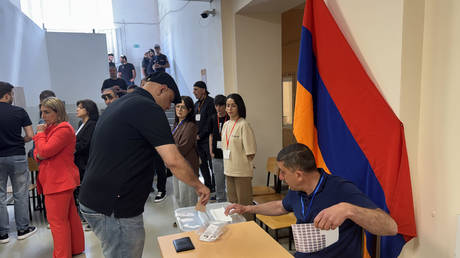
Last month, Pashinyan’s pro-EU ruling party, Civil Contract, came out on top in hotly contested parliamentary elections, securing over 49% of the vote. The opposition has petitioned the constitutional court to annul the results of the June 7 elections, citing alleged violations.