Reports Say Trump Plans to Name Jay Clayton as AI “Czar”
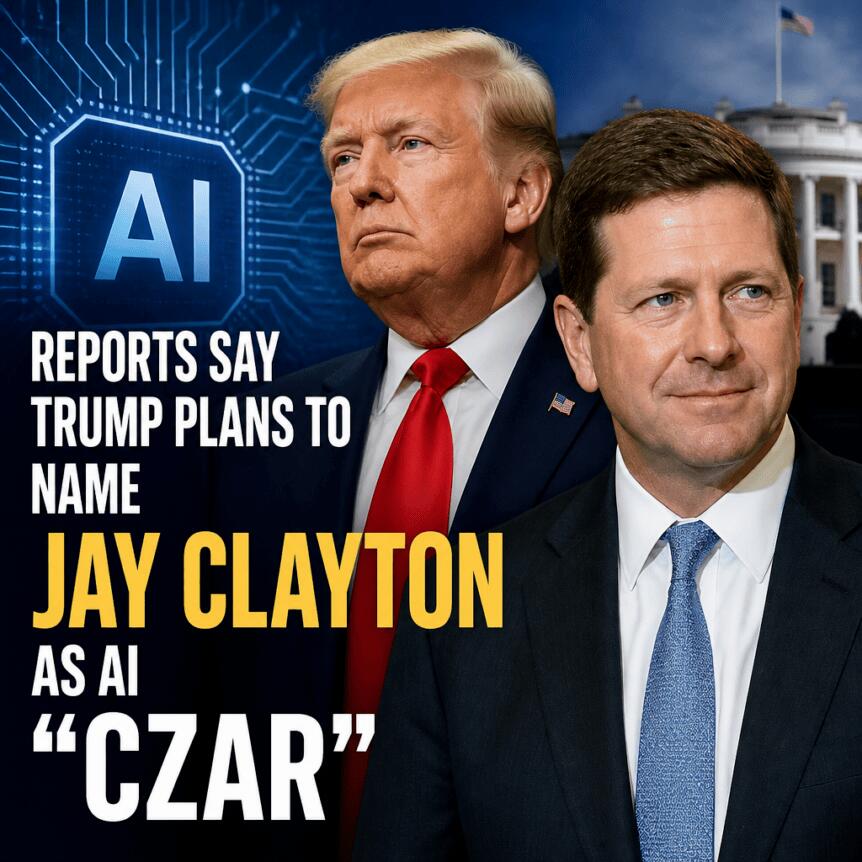 President Donald Trump is reportedly preparing to appoint Jay Clayton—currently US director of national intelligence—as a new “AI czar,” a move media outlets say is aimed at overseeing the rapidly expanding artificial intelligence sector. CNN and other reports cited unidentified sources saying Clayton is expected to be named to lead the White House’s AI push. [...]
President Donald Trump is reportedly preparing to appoint Jay Clayton—currently US director of national intelligence—as a new “AI czar,” a move media outlets say is aimed at overseeing the rapidly expanding artificial intelligence sector. CNN and other reports cited unidentified sources saying Clayton is expected to be named to lead the White House’s AI push.
The announcement would follow a broader campaign theme from Trump’s administration: managing AI without introducing new regulations that could slow innovation. The proposed shift also comes as prominent technology leaders debate whether AI development should be accelerated, slowed, or coordinated through voluntary safeguards.
Key takeaways
Reports say Trump plans to appoint Jay Clayton, the US director of national intelligence, as an AI czar.
Trump’s approach, according to reported statements, emphasizes directing AI activity while avoiding regulations that could hinder innovation.
The wider AI debate has intensified following calls from industry figures to better pace development for safety and controllability.
Earlier commitments described as “self-policing” have been discussed with AI and technology leaders at the White House.
Clayton previously led the SEC and was confirmed by the Senate in July to lead the intelligence community.
Trump’s reported AI leadership plan
According to CNN and other media reports, Trump is expected to appoint Jay Clayton as the next AI czar. The reporting did not frame the decision as legislation-backed, but rather as part of an executive effort to coordinate how the US manages AI’s growth.
Earlier this month, Cointelegraph reported that Trump said the US would create an “AI Force” modeled after the Space Force, alongside appointing an AI czar. In that account, Trump described the project as intended to manage the fast-growing AI sector while steering away from additional regulations that could slow innovation.
This line of thinking aligns with a series of public warnings about AI’s risks, which have increasingly shaped how policy discussions unfold. The question for markets and developers is whether the administration’s emphasis on “self-policing” and coordination will reduce regulatory uncertainty—or instead leave critical safety issues to voluntary standards.
From “AI Force” talk to White House commitments
The reported AI czar plan fits into a sequence of events involving public statements from AI executives and policy signals from the White House.
Cointelegraph previously reported on Sept. 12 that Anthropic CEO Dario Amodei had written a three-step proposal aimed at pacing AI development to a safer rate, warning that advanced systems could “outrun our ability to understand and control these systems” if progress continues unchecked. In response, Cointelegraph said Anthropic later selected Accenture as an “embedded evaluator” to help moderate development speed—moving ahead with the first step in Amodei’s approach.
Not all tech leadership has agreed with the same level of caution. Cointelegraph reported that OpenAI CEO Sam Altman and SpaceX CEO Elon Musk responded positively to Amodei’s proposal, while Nvidia CEO Jensen Huang argued that regulation like this was not necessary.
More recently, CNN reported that Trump brought AI and technology leaders to the White House to sign a new commitment focused on “self-policing” companies’ AI models and development. The pledge was described as urging firms to manage risk internally rather than relying on new rules from the government—an approach that, if widely adopted, could influence how US AI systems are built and evaluated across the industry.
Why Jay Clayton stands out for the job
CBS News first reported that Clayton was the frontrunner for the AI position, but a White House official told CBS that any announcement would come directly from the president, dismissing the reporting as speculation. CNN also reported the expected appointment, again attributing the details to unnamed sources.
Clayton is no stranger to regulatory oversight. During Trump’s first term, he led the US Securities and Exchange Commission. He also previously served as interim US Attorney for the Southern District of New York, and reports say he is expected to retain his current role as director of national intelligence.
According to the reporting cited by CNN, the Senate confirmed Clayton in July to lead the intelligence community. During his confirmation hearing, he described AI as a “game changer” that is both “an opportunity” and “a threat,” underscoring the dual framing that often defines political approaches to advanced technology—promotion alongside risk management.
From an investor and operator standpoint, Clayton’s profile matters because it suggests the administration may treat AI governance less as a purely technical question and more as a matter of oversight, accountability, and enforcement posture—though the exact scope of an AI czar role would be determined by how Trump structures the office.
How this differs from earlier “AI czar” activity
Trump’s reported AI leadership efforts also echo—and potentially build on—prior policy roles tied to AI and crypto. Cointelegraph earlier reported on David Sacks, a venture capitalist who served as a special White House official responsible for crypto and AI concerns.
That reporting explained that special government employees under US rules are limited to 130 days of work in a 12-month period. Cointelegraph said Sacks’ 130-day tenure as crypto and AI czar ended in March, though he continued making policy recommendations in his role as co-chair of the President’s Council of Advisors on Science and Technology.
The proposed appointment of Clayton would appear to be a different mechanism—an intelligence-community-confirmed figure moving into a dedicated AI oversight role—rather than a continuation of the earlier “czar” framework. What remains unclear is whether the new AI czar would focus mainly on safety pacing and internal commitments, or whether the job would also shape enforcement priorities that touch regulated sectors such as securities, disclosures, and market conduct.
Readers tracking the policy trajectory should watch for how the administration defines the AI czar’s mandate—especially whether it centers on compliance-like monitoring, technical evaluation standards, or coordination between agencies and the private sector.
As Trump’s team moves from declarations to appointments, the key uncertainty is how “self-policing” commitments translate into enforceable expectations—if at all—and whether AI pacing proposals like Amodei’s gain broader institutional support. The coming months will likely reveal whether this governance approach reduces fragmentation across the industry or leaves critical risk gaps to negotiation behind closed doors.
This article was originally published as Reports Say Trump Plans to Name Jay Clayton as AI “Czar” on Crypto Breaking News – your trusted source for crypto news, Bitcoin news, and blockchain updates.
About the Author


