Russia’s Finance Ministry Starts Paying Wages in Digital Rubles
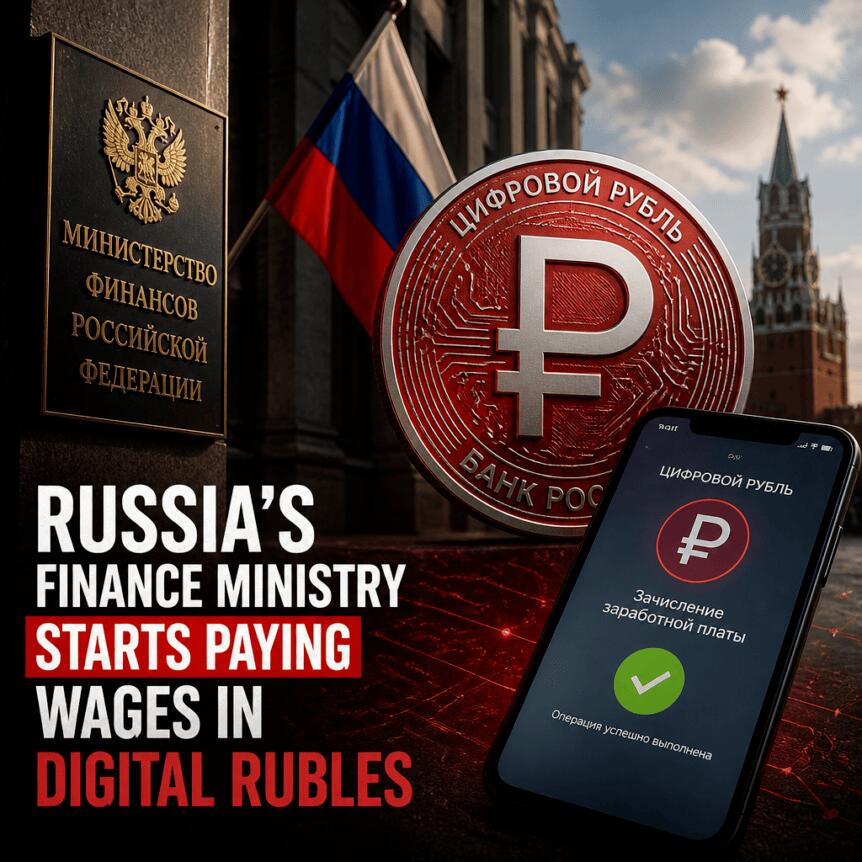 Russia’s Ministry of Finance says some of its employees have started receiving wages in the country’s central bank digital currency, with payments in digital rubles available on a voluntary basis. In a press release published Friday, the ministry stated that the first salary disbursements in digital rubles began Thursday, Oct. 1, and that the program [...]
Russia’s Ministry of Finance says some of its employees have started receiving wages in the country’s central bank digital currency, with payments in digital rubles available on a voluntary basis.
In a press release published Friday, the ministry stated that the first salary disbursements in digital rubles began Thursday, Oct. 1, and that the program is intended to mirror work already carried out in federal budget spending trials in 2025, when digital rubles were used in live disbursements.
Key takeaways
Russia’s Ministry of Finance reported that certain employees were paid their wages in digital rubles for the first time.
The digital ruble wage option is voluntary and started on Thursday, Oct. 1.
The ministry did not disclose how many employees participated or the total payroll amount.
The ministry said the payroll rollout uses “proven rails” from 2025 federal budget spending trials.
Work on integrating the digital ruble into budget processes is being carried out by the Bank of Russia together with the Ministry of Finance.
Voluntary wage payments begin inside the finance ministry
According to the ministry’s press release, the digital ruble wage option is available to citizens of Russia on a voluntary basis, marking the first instance of the Ministry of Finance paying salaries using the digital currency.
The announcement does not provide operational details such as participation levels or the dollar value of payroll affected, but it does confirm that the mechanism is already functioning in a real payroll context, not only in testing scenarios.
“Proven rails” from 2025 budget trials
The Ministry of Finance linked the next step—salary payments—to earlier implementation work. It said that during federal budget spending trials in 2025, about 16 million digital rubles (reported as $192,245) were disbursed, and that the ministry has now applied those established rails to its own wage process.
That matters because it suggests the digital ruble infrastructure required for government-facing payments has already been stress-tested in budget-related flows. While the scale and scope of the ministry’s payroll rollout are not quantified, the ministry’s framing indicates a move from trial usage to additional, routine administrative implementation.
Bank of Russia and Ministry of Finance coordinate the rollout
The press release also states that the introduction of the digital ruble into budget processes is being carried out by the Bank of Russia together with the Ministry of Finance.
For investors and market observers, this coordination is significant because it implies that the digital ruble is being positioned not as a standalone payment experiment, but as an instrument integrated into state payment operations. The more the currency is tied into budget procedures, the more it could function as a parallel rails option for government-related transfers, even if retail and private usage remains subject to policy and technical rollouts.
Earlier plans and the role of sanctions
Russia’s digital ruble development has been underway since 2021, and the currency has faced restrictions linked to sanctions imposed by European authorities. In April, the European Council announced a sanctions package that included measures affecting the digital ruble, describing the package as a response to Russia’s “war of aggression against Ukraine,” which the council said began in February 2022.
Earlier reporting by Cointelegraph on July 2 described Russia’s plan to launch the central bank digital currency on Sept. 1, when major banks and retail companies were expected to begin enabling transactions. At the time, the digital ruble was described as a complement to Russia’s fiat currency, the ruble, with initial acceptance focused on financial and credit institutions—according to Russian state media coverage cited by Cointelegraph.
With the Ministry of Finance now moving into wage payments, the latest step appears consistent with the broader implementation trajectory: starting with controlled institutional adoption and gradually extending use cases within government-linked payments.
What to watch next
Readers should watch whether the Ministry of Finance expands participation beyond its own employees, how quickly the digital ruble option spreads to other budget-linked payment categories, and whether future disclosures include participation figures or more details on payment volumes—data that could help gauge how rapidly the digital currency is shifting from trials to everyday operational use.
This article was originally published as Russia’s Finance Ministry Starts Paying Wages in Digital Rubles on Crypto Breaking News – your trusted source for crypto news, Bitcoin news, and blockchain updates.
About the Author


