DOJ cites Bitcoin Fog ruling, challenging Roman Storm acquittal bid
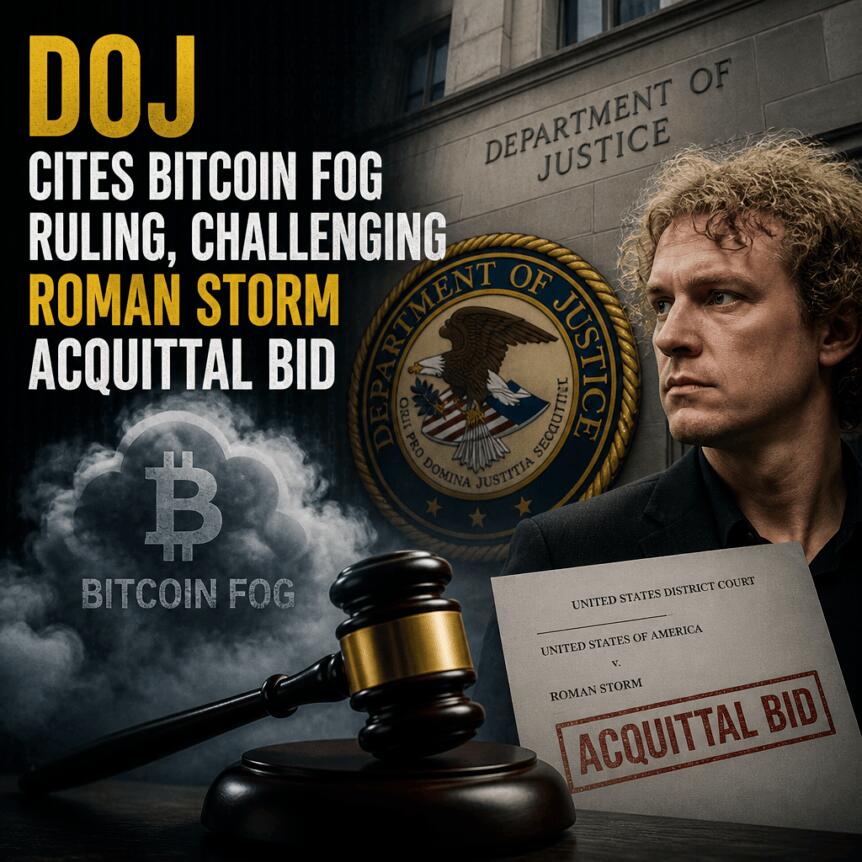 Federal prosecutors have used a recent appeals-court decision in the Bitcoin Fog case to bolster their opposition to the acquittal of Tornado Cash developer Roman Storm, arguing the ruling supports the government’s theory that crypto-mixing activity can establish proper court venue for related charges. In a Monday filing in Storm’s case, the U.S. Department of [...]
Federal prosecutors have used a recent appeals-court decision in the Bitcoin Fog case to bolster their opposition to the acquittal of Tornado Cash developer Roman Storm, arguing the ruling supports the government’s theory that crypto-mixing activity can establish proper court venue for related charges.
In a Monday filing in Storm’s case, the U.S. Department of Justice cited a Sept. 25 decision by the D.C. Circuit affirming the convictions and sentence of Bitcoin Fog operator Roman Sterlingov. Prosecutors said the appeals court’s venue analysis “directly supports” their position that Tornado Cash activity tied to Manhattan was enough to bring Storm’s money-laundering and unlicensed money-transmission conspiracy cases before the Southern District of New York.
Key takeaways
Prosecutors in Roman Storm’s case cited a Sept. 25 D.C. Circuit ruling upholding convictions of Bitcoin Fog’s operator, Roman Sterlingov.
The D.C. Circuit found venue in Washington, D.C. proper based on undercover Bitcoin Fog transactions originating from an agent’s D.C. location and evidence the mixer served customers in the district.
In Storm’s case, prosecutors argue Tornado Cash usage from a Manhattan apartment likewise supports venue in New York for money-laundering and unlicensed money-transmission conspiracy counts.
Judge Katherine Polk Failla is still considering Storm’s post-trial acquittal motion after arguments were heard in April 2026.
A potential retrial on certain deadlocked counts is set for April 26, 2027, if those charges remain pending.
Bitcoin Fog appeals decision becomes venue ammunition
The Monday filing points to the D.C. Circuit’s Sept. 25 opinion affirming Sterlingov’s conviction on venue grounds. According to the court, Washington, D.C. was an appropriate venue for all four counts at issue in that case.
For the money-laundering counts, the appeals court relied on evidence that an undercover agent conducted Bitcoin Fog transactions from his Washington, D.C. office. For the unlicensed money-transmission counts, it determined there was sufficient evidence that the mixer had served customers within the district.
Prosecutors argue that the same logic applies to Storm’s alleged conduct. They maintain that Tornado Cash activity in Manhattan—specifically, testimony tying use of the service to Shakeeb Ahmed from a Manhattan residence—was enough to establish venue for Storm’s related conspiracy charges filed in the Southern District of New York.
That framing matters because venue can be a decisive battleground in criminal prosecutions involving online services. Even where activity occurs through the internet, prosecutors often try to anchor jurisdiction by connecting service use to a particular location or operational footprint.
How prosecutors link mixing “pool expansion” to the alleged conspiracy
Prosecutors also address a core theme from Storm’s post-trial arguments: the idea that Ahmed’s Tornado Cash use from his Manhattan apartment was insufficient, on its own, to prove the transactions furthered the alleged conspiracy.
In Storm’s 2025 motion for acquittal, he argued that Ahmed’s Manhattan use could not establish venue in New York because, in his view, the transactions did not advance the government’s conspiracy theory.
In contrast, prosecutors contend that even brief deposits can play a role in how a mixer functions—by increasing the set of transactions that can be used to obscure the movement of funds. They say that logic applies to Ahmed’s Tornado Cash activity and therefore supports the contention that the use helped further the alleged conspiracy.
The argument is consistent with how the government tends to characterize mixers: not simply as passive tools, but as services that—by design and operation—can facilitate obfuscation when funds are moved through the platform.
Where Storm’s case stands now
Storm’s legal situation stems from a trial that did not end in a fully unanimous verdict. A jury convicted him in August 2025 of conspiring to operate an unlicensed money-transmitting business. However, the same jury deadlocked on the money-laundering and sanctions-conspiracy counts.
Storm subsequently filed a post-trial motion for acquittal in September 2025, arguing that prosecutors failed to prove he intended to help criminals misuse Tornado Cash.
Judge Katherine Polk Failla heard arguments on the acquittal motion in April 2026, but has not yet issued a decision. The schedule also includes the possibility of further proceedings: a retrial on the counts where the jury deadlocked—money-laundering and sanctions conspiracy—is set for April 26, 2027, if those charges remain pending.
The outcome of the venue dispute—now bolstered by the Bitcoin Fog precedent—could affect whether the court proceeds with the remaining charges in the same jurisdiction, or whether Storm seeks other procedural remedies as the case moves toward any retrial.
Storm disputes the approach amid broader crypto policy signals
Storm criticized the Monday filing publicly on X, characterizing the government’s response as continued pursuit “with everything it has.”
Separately, he pointed to a Monday announcement from the Treasury Department regarding a proposed crypto-mixer rule, which he described as conflicting with the government’s stance in court. According to earlier coverage, the Treasury Department said it would withdraw its proposed crypto-mixer rule.
That policy development, while not directly tied to the venue argument in Storm’s case, underscores a larger tension: enforcement actions can proceed on one set of legal theories even as regulators adjust or retreat from certain rulemaking proposals. For defendants and the crypto ecosystem, this creates uncertainty around how “acceptable” privacy-oriented tools are expected to operate in practice and what standard prosecutors will apply in litigation.
As Judge Failla weighs the pending acquittal motion, readers should watch whether the court accepts the government’s reliance on the Bitcoin Fog venue rationale—especially the idea that short-lived deposits can be treated as advancing a conspiracy—and how that decision shapes the likelihood and contours of any April 2027 retrial.
This article was originally published as DOJ cites Bitcoin Fog ruling, challenging Roman Storm acquittal bid on Crypto Breaking News – your trusted source for crypto news, Bitcoin news, and blockchain updates.
About the Author


