Musk Says Over 200 AI Startups Could Fail Under “Guppy-Level” Risk
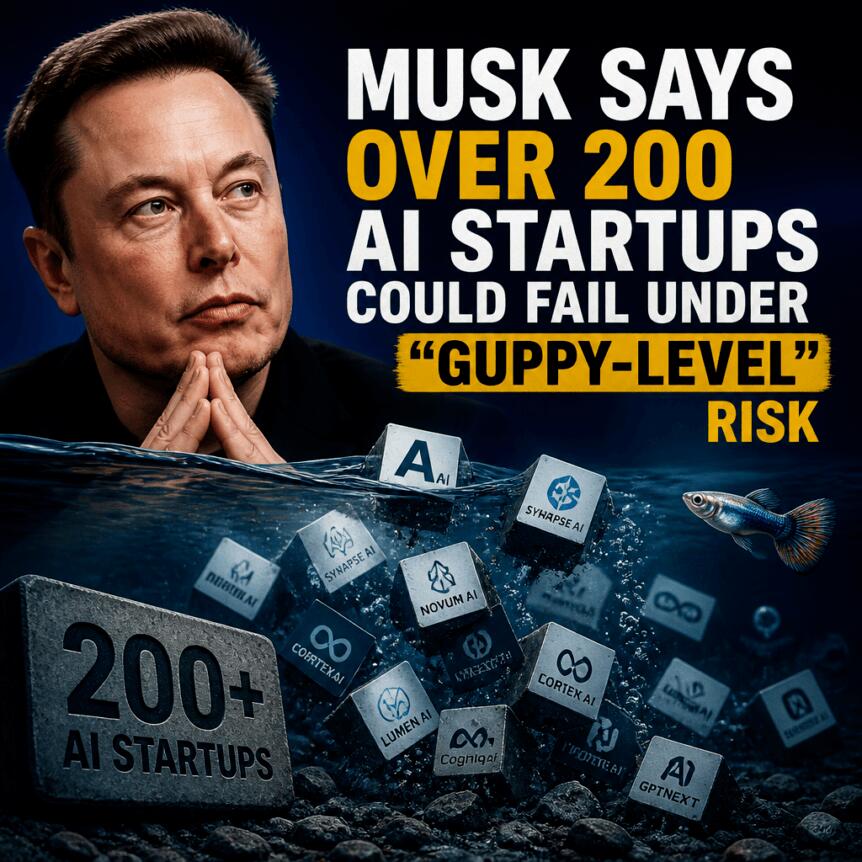 Elon Musk has warned that more than 200 specialist “neocloud” providers—firms offering AI-focused cloud computing, often backed by GPU-heavy data centers—could face collapse or consolidation as lenders become more selective about funding. Speaking on X, Musk said financing is increasingly being limited to companies with substantial revenue streams beyond AI data center operations. His remarks [...]

Elon Musk has warned that more than 200 specialist “neocloud” providers—firms offering AI-focused cloud computing, often backed by GPU-heavy data centers—could face collapse or consolidation as lenders become more selective about funding. Speaking on X, Musk said financing is increasingly being limited to companies with substantial revenue streams beyond AI data center operations.
His remarks point to a broader risk facing the AI infrastructure buildout: even with rapid spending growth, many smaller providers may struggle to turn massive capital expenditures into sustainable, profitable cash flows. The warning follows a Gartner forecast that suggests most neocloud operators will not remain independent through the end of the decade.
Key takeaways
Musk said lenders have largely stopped funding neoclouds unless they have meaningful revenue outside AI data centers.
He argued SpaceX was able to secure $40 billion in debt financing for GPUs due to its investment-grade profile and revenue from Starlink and rocket businesses.
Gartner projects that more than 80% of neocloud providers could cease operating independently by 2030.
Gartner expects very large AI infrastructure spending—nearly $1 trillion in 2026 and $6 trillion from 2027 to 2030—while warning that not all providers will achieve profitable returns.
Musk ties AI cloud financing to real revenue durability
On X, Musk said Sunday that lenders have “largely stopped” providing financing to companies without substantial revenue streams outside their AI cloud operations. In his framing, that shift effectively raises the bar for survival among smaller, specialized providers.
Musk illustrated the difference using SpaceX’s position. He said the company secured $40 billion in debt financing for GPUs, attributing the ability to access funding to its investment-grade status and to revenue generated by Starlink’s satellite internet and its rocket business.
From that perspective, Musk suggested neoclouds may not be able to withstand tighter credit conditions. “That means the 200+ neoclouds are going to see guppy-level death and consolidation,” he wrote, adding that “some will make it through, but not many.”
Gartner forecast flags a profitability gap behind the AI buildout
Musk’s warning aligns with a Gartner forecast released in October. Gartner said more than 80% of neocloud providers could stop operating independently by 2030, citing the difficulty of generating sufficient returns on the massive investments required to support AI workloads.
Gartner’s central concern was not the pace of AI spending, but the economics. In its forecast, the firm projected that AI providers are expected to spend nearly $1 trillion on infrastructure in 2026 and another $6 trillion between 2027 and 2030. Yet it warned that there is insufficient revenue to deliver profitable returns on all of that investment.
The forecast also highlighted structural differences between large and smaller players. Larger cloud companies, according to Gartner, have more diversified revenue streams that can support AI-related spending for longer periods. Specialist neoclouds, by contrast, depend heavily on the profitability of AI computing services to sustain operations.
Even fast growth may not be enough before the next chip cycle
Gartner also pointed to the risk that market expansion alone may not solve the timing problem created by rapid hardware turnover. The firm forecast that spending on AI-optimized infrastructure-as-a-service would rise from $66 billion in 2027 to $174 billion in 2030, but it cautioned that many providers could struggle to recover their investment before the current generation of AI chips is replaced.
That “payback window” matters in practice: GPU and data center buildouts are capital-intensive, and if competitive dynamics force pricing pressure—or if demand ramps slower than expected—providers may find themselves unable to generate enough revenue in time to justify the investment before the next hardware cycle.
For investors and operators, the implication is straightforward: surviving in AI infrastructure may increasingly require either scale, diversified revenue, favorable cost structures, or access to capital that does not depend solely on near-term cash flow from AI services.
Why the warning matters to crypto mining firms shifting toward AI
The tightening funding environment described by Musk and forecast by Gartner may also affect parts of the crypto ecosystem that have been exploring AI infrastructure. Earlier coverage from Cointelegraph noted that some Bitcoin miners have pivoted toward AI-adjacent business models by targeting demand for computing power.
For example, Cointelegraph reported that IREN has expanded into AI cloud services by renting computing power to customers. It also reported that Core Scientific provides data center hosting for neocloud customers such as CoreWeave. If neoclouds consolidate or face funding constraints, the downstream demand for hosted capacity and managed compute could change—either through fewer independent buyers, renegotiated contracts, or greater emphasis on providers with stronger financial backstops.
Still, these impacts are unlikely to be uniform: some hosting and infrastructure operators may benefit if consolidating neoclouds migrate workloads to fewer larger platforms. The key uncertainty is how much the credit squeeze reduces total AI infrastructure utilization versus merely reshuffling market share.
SpaceX’s recent revenue surge underscores the “creditworthiness” argument
Musk’s comments also came shortly after SpaceX reported a sharp increase in revenue tied to its “Super Intelligence” business. According to Cointelegraph’s reporting, SpaceX said the segment generated $7.6 billion in third-quarter revenue—up 830% year over year—and accounted for more than half of the company’s $14.6 billion in quarterly sales.
Cointelegraph said SpaceX attributed the growth to new cloud services agreements, its acquisition of Cursor, and increased adoption of its Grok AI model. While that does not directly prove neoclouds can access the same financing terms, it supports Musk’s underlying claim: debt and capital markets appear more willing to fund AI infrastructure when the broader company can demonstrate durable revenue and stronger credit metrics.
With lenders tightening and consolidation risks rising, readers should watch whether specialist AI cloud operators can improve unit economics before chip cycles turn over—and whether miners and other compute providers see contract demand stabilize, shift, or concentrate as the market consolidates.
This article was originally published as Musk Says Over 200 AI Startups Could Fail Under “Guppy-Level” Risk on Crypto Breaking News – your trusted source for crypto news, Bitcoin news, and blockchain updates.
About the Author


