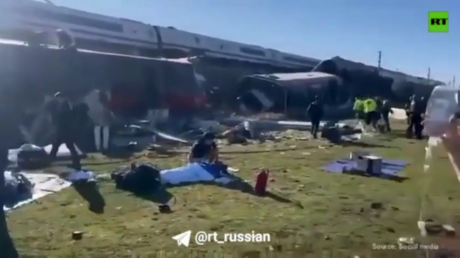
Protesters clashed with police in Madrid as they demanded resignations following a high-speed train collision that killed at least 68 people
Protesters clashed with police outside the Transport Ministry in Madrid as they demanded accountability for a high-speed train collision that killed at least 68 people near Toledo.
Wednesday’s crash near Urda, in Toledo province, was Spain’s second major rail disaster in less than ten months. On January 18, a train derailed near Adamuz, in Cordoba province, and collided with another train traveling in the opposite direction, killing 46 people.
According to elDiario.es, the demonstration, organized by far-right groups Falange and Revuelta, demanded the resignations of Prime Minister Pedro Sanchez and Transport Minister Oscar Puente. “How many more people have to die before we throw these murderers and traitors out of our institutions?” Falange spokesman Federico Campanero said in a speech.
Ministerio de transportes ahora mismo. https://t.co/5WOlae1nzq
Some protesters threw flares and other objects at police, who pushed back the crowd and used tear gas.
La manifestación frente al ministerio de transportes exigiendo la dimisión de Óscar Puente se calienta. La gente está hasta los cojones. https://t.co/KGcoYNeIjU
The right-wing Vox party and its affiliated trade union Solidaridad held a separate demonstration earlier at Plaza de Cibeles in central Madrid, where participants observed a minute of silence. Some carried a banner reading “Corruption kills.” The rally ended without major incidents.
Audio recordings obtained by El Pais suggest that rail traffic controllers violated safety protocols before the deadly collision. A controller reportedly instructed an AVE train to resume normal speed without confirming that the track ahead was clear, rather than restricting it to 40 km/h as required. Despite repeated warnings from the driver of a stationary Iryo train, controllers failed to stop the approaching AVE, which collided with the stranded train minutes later.
In a speech on Wednesday, Sanchez promised a thorough investigation. “It is unacceptable for a country like Spain to suffer two high-speed rail accidents in the same year,” he said.
Alberto Nunez Feijoo, leader of the main opposition People’s Party, demanded an immediate investigation and an independent review of the railway network. “Spain has the right to know what is happening with its infrastructure, what condition the tracks and safety systems are in,” he said.
The disaster comes at a politically sensitive moment for Sánchez, whose government has faced public anger over housing costs and parliamentary setbacks. With a general election scheduled for November 29, the collision has brought renewed scrutiny of the government’s handling of railway safety.