Report: Nvidia Could Face Tougher U.S. Policy After Election
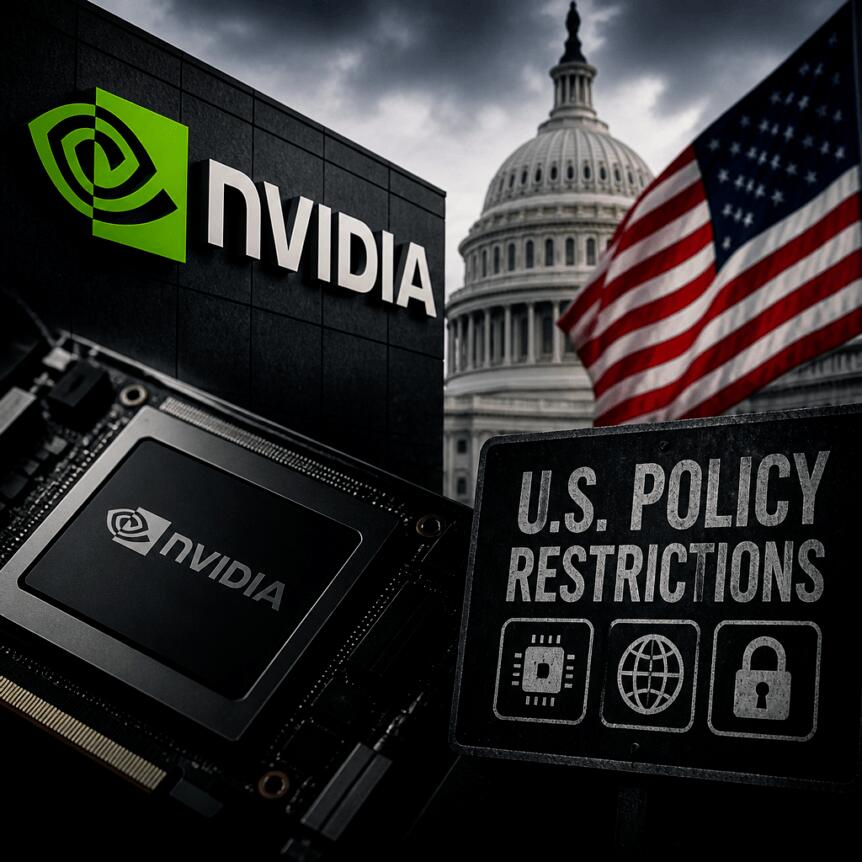 Nvidia CEO Jensen Huang’s close ties to Washington are unlikely to fully shield the chipmaker from a tougher U.S. policy environment after the election, according to a report by Semafor. Even if Democrats position themselves to shape regulatory oversight, Republicans are still signaling a willingness to tighten export controls on advanced chips—an issue that sits [...]

Nvidia CEO Jensen Huang’s close ties to Washington are unlikely to fully shield the chipmaker from a tougher U.S. policy environment after the election, according to a report by Semafor.
Even if Democrats position themselves to shape regulatory oversight, Republicans are still signaling a willingness to tighten export controls on advanced chips—an issue that sits at the heart of U.S. technology competition with China.
Key takeaways
Semafor reports that Nvidia faces growing political pressure in a post-election Washington, despite Jensen Huang’s ties to the Trump White House.
Three Republican House members have asked Huang to appear in a briefing about whether he was targeted by a Chinese intelligence agent.
Democratic Sen. Elizabeth Warren is pushing for Huang to testify regarding Nvidia’s chip sales to China and related topics.
The export controls debate remains the core fault line, with both parties appearing engaged—just from different angles.
Political pressure builds on Nvidia’s leadership
Semafor’s Friday report suggests Nvidia’s relationship with top U.S. officials may not translate into lasting insulation from more aggressive scrutiny. The outlet frames the shift as a broader “post-election” environment in which Washington’s oversight priorities harden—particularly around export controls and U.S. national security concerns tied to advanced semiconductors.
In that context, Semafor says three Republican House members have requested that Huang appear in a briefing about whether he had been targeted by a Chinese intelligence agent. The request underscores how questions of security and influence may become intertwined with technology policy in the near term.
Opposition from Democrats centers on China export exposure
The scrutiny is not limited to Republicans. Semafor also reports that Democratic Sen. Elizabeth Warren wants Huang to testify in Congress about Nvidia’s chip sales to China and other related issues.
While the parties may differ in emphasis, both tracks point toward a common topic: how advanced chips move across borders, who receives them, and what U.S. policy tools should regulate that flow.
Export controls remain the strategic flashpoint
Semafor’s report comes amid continuing debate over the scope and enforcement of U.S. export restrictions for high-end chips. Huang has reportedly already met with President Donald Trump to discuss export controls for Nvidia’s chips, indicating the company has been engaging at the highest level.
However, Semafor’s central point is that personal relationships—however influential—may not be enough to prevent increasingly tough legislative and oversight pressure from taking hold as political alignments change.
Technology ties to Trump’s advisory structure add complexity
Earlier reporting by Cointelegraph noted in March that Trump appointed figures from the crypto, blockchain, AI, and technology sectors to his Council of Advisors on Science and Technology, including Jensen Huang. That appointment highlighted how the Trump administration has sought to include leading technology executives in policy-adjacent roles.
At the same time, the newer developments described by Semafor reflect that involvement in advisory structures does not necessarily reduce congressional scrutiny—especially on issues connected to China and export control regimes.
As these briefings and potential testimony requests progress, investors and market participants will likely watch for two things: whether regulators tighten export rules further or refine enforcement priorities, and how Congress frames the national-security rationale behind any new constraints. The timeline and practical impact will depend on legislative follow-through, but the direction of travel suggested by both parties’ actions is toward greater oversight of Nvidia’s China-related business.
This article was originally published as Report: Nvidia Could Face Tougher U.S. Policy After Election on Crypto Breaking News – your trusted source for crypto news, Bitcoin news, and blockchain updates.
About the Author


