SEC Charges 8 Firms in Fake Crypto Platform Case Tied to $37M Fraud
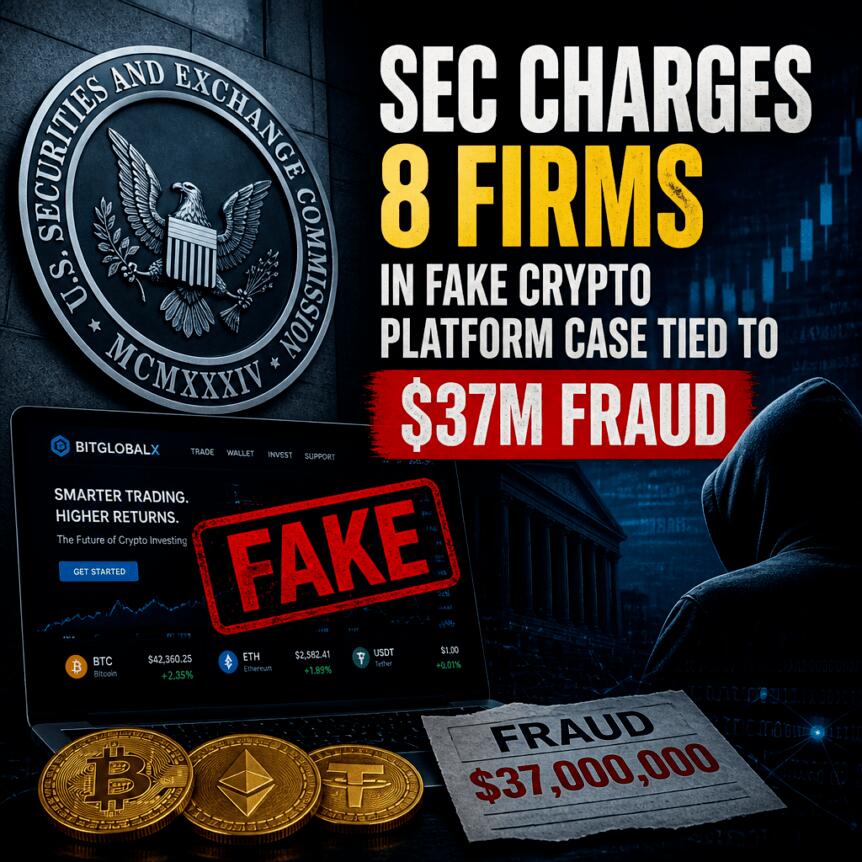 The U.S. Securities and Exchange Commission has filed fraud charges against eight Colorado-based entities accused of orchestrating a $37 million-plus scheme targeting investors. According to the SEC, the defendants allegedly posed as investment advisers and trading representatives, then steered victims to deposit funds into fake crypto asset platforms designed to siphon money rather than enable [...]

The U.S. Securities and Exchange Commission has filed fraud charges against eight Colorado-based entities accused of orchestrating a $37 million-plus scheme targeting investors. According to the SEC, the defendants allegedly posed as investment advisers and trading representatives, then steered victims to deposit funds into fake crypto asset platforms designed to siphon money rather than enable legitimate trading.
In an SEC press release issued Thursday, the agency described a multi-stage operation in which scammers first offered stock-trading guidance and later convinced victims to transfer funds to websites that pretended to be real exchanges. The SEC also said overseas actors likely played a central role, using social media advertisements to recruit victims into private chat groups.
Key takeaways
The SEC alleges the defendants defrauded U.S. investors of more than $37 million through fake adviser and crypto trading platforms.
Authorities say victims were lured through private chat groups, where scammers transitioned from stock-trading pitches to directing deposits into fraudulent crypto “exchanges.”
The scheme allegedly relied on fake compliance materials, including forged “SEC certificates” and filings submitted under multiple regulatory bodies.
The SEC characterizes the conduct as an impersonation-based fraud pattern, consistent with prior investor warnings about chat-driven investment scams.
How the alleged scheme worked
The SEC’s complaint centers on the mechanics of the alleged scam. The agency says the defendants presented themselves as investment advisers or as representatives of crypto asset trading platforms—roles the SEC described as disguises for an operation aimed at extracting investor funds.
Prosecutors allege the scammers used social media ads to draw in potential victims and moved conversations into private online chat groups, where—according to the SEC—fraudsters initially provided stock-trading advice. The pitch then reportedly shifted: victims were encouraged to transfer money to “crypto platforms” that the SEC says were not genuine exchanges, but rather fronts built to facilitate theft.
To reinforce credibility, the SEC alleges the defendants created fake “SEC certificates” and submitted filings designed to appear legitimate, including materials filed with the SEC, FINRA, and FinCEN. The agency also claims that individuals located overseas likely operated key parts of the operation.
Switching advisers and platforms over time
The SEC alleges the fraud did not operate through a single static brand. Instead, it says the scheme ran through four consecutive adviser-platform pairings from August 2024 to May 2026. The SEC states that the operators switched between these pairings every few months, a strategy that can make scams harder to detect, disrupt, or trace to a single entity over time.
That “rotating pairs” approach matters for investors because it suggests the public-facing names and platforms may change while underlying tactics remain consistent. In practice, this can affect how quickly victims or intermediaries notice red flags if the scam updates its surface-level identity.
Who was charged by the SEC
According to the SEC, the eight charged entities are: Advisor WeChat Capital, Tech Brokerage Asset Alliance Ltd., HB Wealth Advisors, IdeaCrypto Exchange LLC, Convergent Wealth Advisors Inc., RealSimple Crypto Exchange Inc., Associated Wealth Advisors Ltd., and Essential Crypto Exchange.
The SEC’s framing emphasizes that these businesses allegedly served as the public face of a broader impersonation and deception effort. By tying the operation to adviser-like personas and crypto platform imagery, the SEC says the scheme exploited common investor expectations around regulated access to markets.
Why the SEC says this fits a broader scam pattern
This case also aligns with prior SEC investor warnings about group-chat fraud. In a December 2025 Investor.gov alert, the SEC warned that scammers increasingly use investment-related group chats to promote fraud schemes—often by impersonating financial professionals and exploiting the trust dynamics that form in private communities.
In Thursday’s announcement, SEC enforcement leadership reinforced that theme. Laura D’Allaird, chief of the SEC Enforcement Division’s Cyber and Emerging Technologies Unit, said the agency continues to pursue and expose fraudulent investment scams that prey on U.S. investors, adding that the public can report such schemes through the SEC’s online portal.
For readers, the takeaway is not just that this particular case involved fake crypto exchanges. The SEC’s description—social recruitment via ads, movement into private chat groups, an initial “legitimate” investment conversation that escalates into deposit demands, and attempts to fabricate regulatory legitimacy—captures a repeatable structure scammers can follow.
Enforcement momentum and what investors should watch next
The SEC’s broader enforcement activity provides additional context. During fiscal year 2026, the SEC filed 348 enforcement actions, a decrease of 23.7% from 456 the year prior, while 13 crypto-related actions were filed in calendar year 2025, down from 33 in 2024, according to research cited by Cornerstone Research.
Even with that year-over-year decline in crypto-specific filings, the agency continues to bring targeted cases that combine cyber-style recruitment tactics with impersonation and market-facade strategies. In this instance, the SEC’s allegations include both the operational flow (from advice to deposits into fake platforms) and attempts to counterfeit compliance signals.
Investors watching this space should focus on the mechanics described by the SEC: whether communications are pushed into private groups, whether “platform” access only appears after initial trading talk, and whether any purported regulatory legitimacy is backed by verifiable, independent information rather than screenshots, certificates, or filings presented by the counterparty. As the case proceeds, the next key developments will likely be how the SEC substantiates the alleged offshore involvement and how the rotating adviser-platform structure is mapped to specific controls and communications.
This article was originally published as SEC Charges 8 Firms in Fake Crypto Platform Case Tied to $37M Fraud on Crypto Breaking News – your trusted source for crypto news, Bitcoin news, and blockchain updates.
About the Author


