Aave DAO Approves $25M Grant and Token Allocation for Aave Labs
 Aave Labs, the core development team behind the Aave protocol, has secured a substantial financing package from its own DAO to accelerate growth and product development. In a governance vote that closed with strong support, the Aave community approved a plan that allocates $25 million in stablecoins to Aave Labs, complemented by a grant of [...]
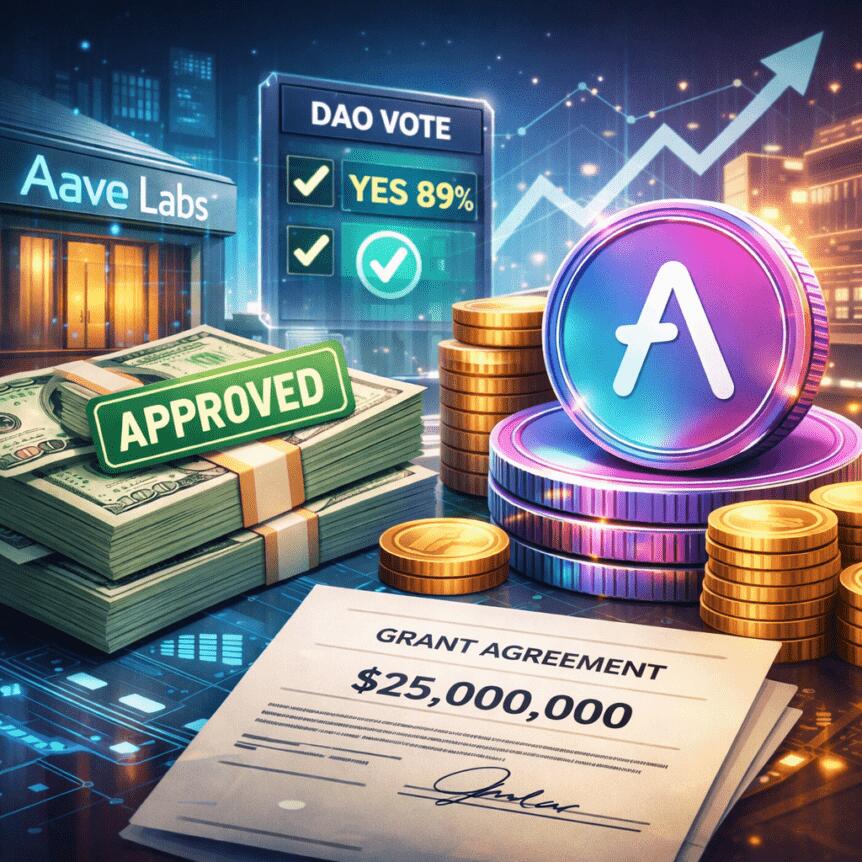
Aave Labs, the core development team behind the Aave protocol, has secured a substantial financing package from its own DAO to accelerate growth and product development. In a governance vote that closed with strong support, the Aave community approved a plan that allocates $25 million in stablecoins to Aave Labs, complemented by a grant of 75,000 AAVE tokens. The framework, dubbed “Aave Will Win,” envisions a shift toward a DAO-funded operating model with revenue generated by Aave products flowing into the DAO treasury.
The proposal passed on Saturday with nearly 75% in favor. Under the terms, the stablecoins will be disbursed over 12 months, while the 75,000 AAVE tokens will vest linearly over four years. The governance dashboard confirms the timing and vesting schedule, marking a formal reconfiguration of how Aave allocates resources for development and growth.
In announcing the decision, Aave founder Stani Kulechov used social media to frame the moment as a watershed for the protocol. “Aave Will Win is the most important proposal in Aave’s history and it just passed with a landslide,” he wrote on X. “If you own AAVE, you own not just the economic rights of the protocol, but the brand, the users, and the integrations. This is the direction we are committing to, a multi-year journey. The foundation is set. Now it’s time to build. Aave will win.”
Beyond the immediate funding, the framework sets out a broader reorganization. Aave V4 is designated as the protocol’s long-term technical foundation, and a new foundation would steward the Aave brand. Aave Labs would focus exclusively on Aave-related products, while the DAO treasury would receive revenue from products such as Aave Pro, ensuring ongoing financial support independent of the centralized development entity.
In parallel, the framework provides room for separate governance proposals to fund growth and development tied to product launches and milestones. These could take the form of targeted grants or milestone-based disbursements, allowing the community to steer investments toward specific features or initiatives without reworking the core operating model each time.
Historically, Aave’s governance has been a balancing act between centralized development control and decentralized decision-making. The current plan marks a notable shift: it moves the funding engine from Aave Labs’ balance sheet toward a DAO treasury funded by the protocol’s own activity, explicitly tying future success to broad community governance and alignment of incentives among developers, users, and builders.
Key takeaways
DAO-backed funding of Aave Labs: $25 million in stablecoins disbursed over 12 months to support operations and growth.
Incentivized ownership: 75,000 AAVE tokens vest over four years to align developer incentives with long-term protocol success.
DAO treasury model: Revenue from Aave products would flow to the DAO treasury, signaling a shift toward a DAO-funded operating model.
Aave V4 and brand stewardship: The framework codifies Aave V4 as the core technical foundation and creates a separate foundation to manage the brand.
Process and governance dynamics: The proposal followed a historical arc of governance debates, including prior concerns about funding size, token allocations, and revenue definitions.
What the vote changes for Aave Labs and the broader DAO
The core aim of the Aave Will Win framework is to de-emphasize centralized control in day-to-day operations while expanding the community’s role in funding and guiding development. By moving revenue from products such as Aave Pro into the DAO treasury, the community gains a more direct stake in the protocol’s ongoing evolution. This could translate into faster iteration on user-facing tools, tighter alignment between feature delivery and community priorities, and potentially more resilient funding during market downturns, as treasury resources are not solely dependent on a single entity’s balance sheet.
At the same time, the plan introduces new governance dynamics. The 75,000 AAVE tokens carry voting power and represent a tangible commitment by the community to align incentives with long-term outcomes. Some participants voiced concerns during the lead-up to the vote about the size of the funding package and the concentration of voting power in tokens, which could influence future protocol decisions. The governance process also flagged questions about how revenue is defined and counted for treasury allocations.
Looking back, the path to this moment included earlier tensions within the Aave ecosystem. A major governance delegate, the Aave Chan Initiative, stepped back from the DAO due to governance standard concerns and voting dynamics. Earlier in the year, a proposal to transfer brand assets and intellectual property to a DAO structure likewise failed, underscoring the challenges of translating aspiration into an operational model that the entire community can rally around. The team has argued that the new structure would streamline operations, accelerate development, and position Aave to compete more effectively as fintechs and institutions increasingly move on-chain in regulated environments.
Implications for investors, users, and builders
From an investor and builder standpoint, the framework represents both opportunity and risk. On the upside, a formalized, DAO-backed funding mechanism could unlock more aggressive product development cycles, improved coordination across teams, and clearer long-term incentives for engineers and product teams. For users, the potential is a faster cadence of feature releases, improved risk management tools, and more robust integrations with on-chain products as the ecosystem matures around a centralized yet widely distributed governance model.
However, the transition is not without uncertainties. The DAO treasury’s performance will hinge on the protocol’s revenue streams and the community’s ability to govern effectively in a broader regulatory and macroeconomic context. Governance fatigue, misaligned incentives, or disputes over future revenue definitions could complicate execution. Market participants will want to watch how the separate grants tied to specific product launches are structured and how quickly they translate into tangible deliverables.
Macro context matters as well. Aave remains one of DeFi’s largest players by total value locked, with DeFiLlama data showing a multi-billion dollar footprint. A successful transition to a DAO-led operating model could serve as a blueprint—and a test case—for other major DeFi projects exploring similar governance and funding arrangements in an increasingly regulated, investor-driven landscape.
What comes next
With the “Aave Will Win” framework approved, attention shifts to the execution phase. The DAO will need to translate the approved funding and vesting schedules into concrete operational milestones, establishing governance processes for ongoing treasury management, grant distribution, and product roadmaps. The community will also be watching for how the new Aave foundation and the renamed or restructured Aave Labs interface with product teams, risk management, and compliance-related considerations as markets evolve.
As Stani Kulechov signaled, the foundation has been set for a multi-year journey. The coming quarters will reveal how effectively the protocol can scale its governance-driven model without sacrificing speed and user-centric innovation. Investors and builders should remain attentive to how the DAO governs revenue definitions, how milestones are operationalized, and how the broader ecosystem responds to a more decentralized yet financially empowered Aave.
Overall, the vote represents a deliberate step toward embedding the protocol’s growth within a community-led framework. If the model succeeds, it could recalibrate expectations for how DeFi projects fund development and align incentives across developers, users, and strategic partners in the years ahead.
Watch for forthcoming governance proposals that will detail the distribution of growth and development grants, the specifics of the Aave V4 roadmap, and the formal establishment of the new foundation to steward the brand. The coming updates will indicate how quickly this ambitious transition translates into measurable product outcomes and wider market adoption.
This article was originally published as Aave DAO Approves $25M Grant and Token Allocation for Aave Labs on Crypto Breaking News – your trusted source for crypto news, Bitcoin news, and blockchain updates.
About the Author


