Rain Pushes for US Bank Charter Days After OCC Crypto Lawsuit
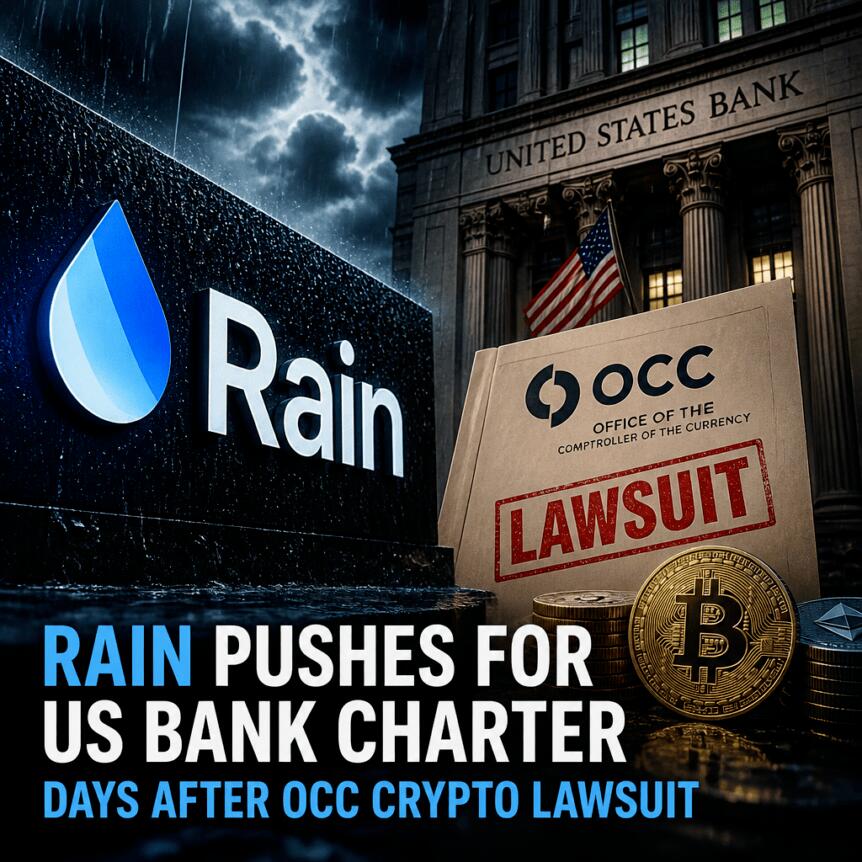 Stablecoin payments infrastructure provider Rain has taken another step toward traditional finance by filing an application with the U.S. Office of the Comptroller of the Currency (OCC) to establish a New York–headquartered national trust bank. If approved, Rain National Trust Bank would be positioned to provide regulated custody for both digital assets and U.S. dollars [...]
Stablecoin payments infrastructure provider Rain has taken another step toward traditional finance by filing an application with the U.S. Office of the Comptroller of the Currency (OCC) to establish a New York–headquartered national trust bank. If approved, Rain National Trust Bank would be positioned to provide regulated custody for both digital assets and U.S. dollars for institutional clients, along with stablecoin-related reserve management.
Rain’s filing also places it within a broader push from crypto and payments firms seeking OCC trust bank charters over the past year. At the same time, community banking groups have escalated legal opposition to the OCC’s framework for crypto-related trust charters.
Key takeaways
Rain filed with the OCC to create Rain National Trust Bank, with plans spanning fiduciary custody, reserve management, and dollar-backed stablecoin issuance/redemption in line with the GENIUS Act.
Rain’s proposed leadership includes Brandon Soto, former Square Financial Services CFO, as president and CEO subject to OCC review.
Modern Treasury also announced an application to seek a U.S. trust bank charter for digital asset custody and related fiat services.
Independent Community Bankers of America (ICBA) sued the OCC, arguing the regulator exceeded its authority and created an overly permissive path for non-depository trust banks.
The lawsuit targets OCC’s chartering rule and an interpretive letter, and seeks to block further approvals relying on them.
Rain seeks an OCC-approved trust bank for stablecoin services
Rain said Monday it filed an application with the OCC to establish Rain National Trust Bank. The proposal is designed to expand what a regulated national trust bank could do for institutional customers in the stablecoin ecosystem.
According to Rain, if the bank receives approval, it would be able to offer fiduciary custody for digital assets and U.S. dollars, manage reserves for permitted stablecoin issuers, and issue and redeem dollar-backed stablecoins in accordance with the GENIUS Act. The company framed the charter as a way to ensure that assets backing customer programs are held by an entity accountable to a federal regulator.
Rain CEO and co-founder Farooq Malik said: “The institutions building on Rain want the assets behind their programs held by a fiduciary that answers to a federal regulator.” The statement underscores Rain’s positioning of itself as a compliance-focused rails provider rather than a consumer-facing stablecoin issuer.
Who would lead the proposed bank?
Rain’s application names Brandon Soto—described as former Square Financial Services chief financial officer—as the planned president and CEO of the proposed national trust bank. As with most charter processes, his appointment would be subject to OCC review before any final approval.
For market participants, leadership is often more than a governance detail: trust bank approvals require both regulatory scrutiny and confidence in internal controls, risk management, and the ability to operate within federal standards. The nomination therefore signals Rain’s intention to meet the governance expectations associated with a new depository-adjacent financial institution, even though trust banks are structured differently from traditional banks.
More charter applications, but mounting legal resistance
Rain’s filing arrives amid an expanding list of crypto-adjacent firms pursuing national trust bank charters. Payments infrastructure company Modern Treasury also announced on Monday that it submitted an application seeking approval to offer digital asset custody and related fiat services, according to coverage noted by Cointelegraph: Modern Treasury seeks US trust bank charter for stablecoin custody.
But these moves are drawing pushback from community banks, particularly regarding how OCC’s trust bank framework overlaps with activities that critics view as higher-risk and insufficiently regulated.
ICBA sues the OCC over crypto trust charter authority
On Friday, the Independent Community Bankers of America sued the OCC, alleging the regulator exceeded its authority by allowing non-depository trust banks to conduct extensive non-fiduciary activities. The lawsuit was filed in the U.S. District Court for the District of Columbia against the OCC and Comptroller Jonathan Gould, according to earlier reporting referenced by Cointelegraph: Community banks sue OCC over trust bank charters of crypto firms.
In its complaint, ICBA argues that OCC’s National Bank Chartering final rule and an interpretive letter from 2021—cited as 1176, 2021—“perversely allow entities engaged in highly risky cryptocurrency and digital assets activities to enter the banking system under lightly regulated national charters rather than the more rigorously regulated traditional bank charter.”
ICBA further contends that the current framework gives crypto trust banks a competitive advantage. The group also raises consumer protection concerns, arguing that the “national bank” designation could be misunderstood as a signal that customer assets are federally insured in the way consumers often associate with traditional banks.
The ICBA is asking the court to overturn OCC’s March 2026 chartering rule and the 2021 interpretive letter, and to prevent additional charter approvals that rely on those authorities.
Crypto industry advocacy groups, meanwhile, have criticized the lawsuit as an attempt to restrain innovation. Earlier coverage from Cointelegraph noted Crypto Council for Innovation’s characterization of the case as “attempt to stifle innovation”: Crypto advocacy groups: ICBA lawsuit OCC charters.
In the ICBA’s complaint, the group also alleges that OCC has approved or conditionally approved at least 21 trust banks, with at least 13 described as crypto companies. While those figures come from ICBA’s filing, they provide a sense of the breadth of activity that prompted the legal challenge.
What investors and builders should watch next
Rain’s application highlights how stablecoin infrastructure providers are increasingly seeking a bank charter path to custody, reserves, and issuer-like functions—yet the pace of approvals may depend on the outcome of the broader legal fight over OCC’s authority and the interpretation of trust bank scope. Until courts or regulators clarify where the line sits between fiduciary roles and other permitted activities, companies pursuing charters will likely need to prepare for continued regulatory uncertainty alongside growing competition for compliant market positioning.
This article was originally published as Rain Pushes for US Bank Charter Days After OCC Crypto Lawsuit on Crypto Breaking News – your trusted source for crypto news, Bitcoin news, and blockchain updates.
About the Author


