Bitcoin $64.5K Rally Shows Low-Volume Liquidity Trap, Analysis Says
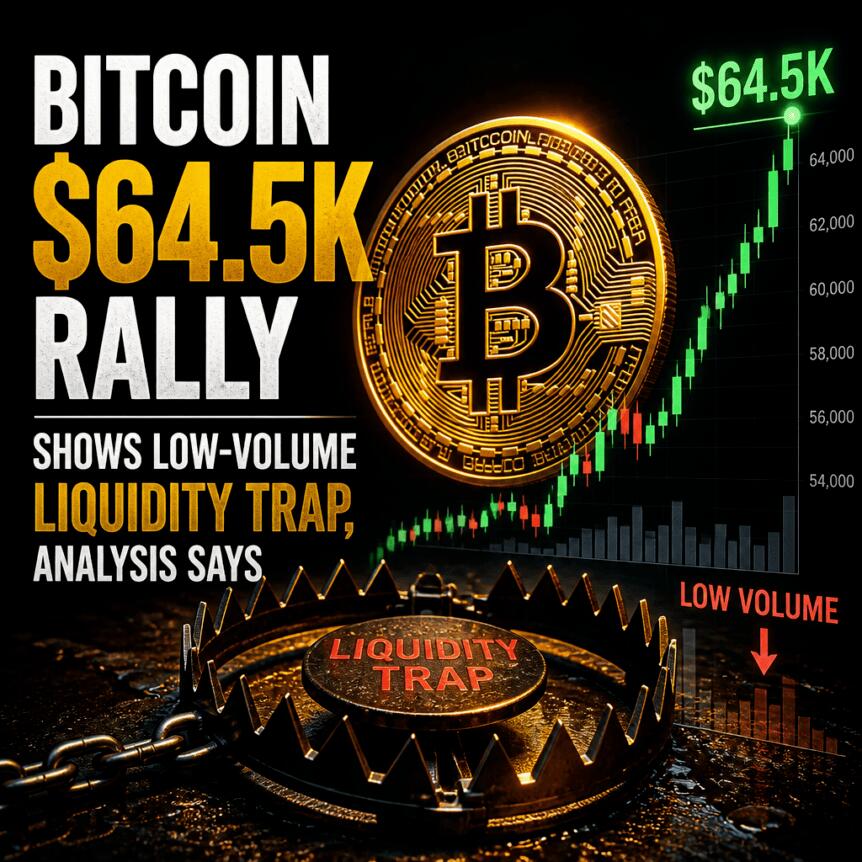 Bitcoin’s rally above $64,000 on Monday was accompanied by a sharp spike in derivative-driven risk events, with short liquidations reaching their highest level in nearly a month. The move pushed BTC to around $64,550 on Bitstamp, according to market charting referenced by Crypto news coverage. On-chain analytics firm CryptoQuant linked the upswing to crowded short [...]
Bitcoin’s rally above $64,000 on Monday was accompanied by a sharp spike in derivative-driven risk events, with short liquidations reaching their highest level in nearly a month. The move pushed BTC to around $64,550 on Bitstamp, according to market charting referenced by Crypto news coverage.
On-chain analytics firm CryptoQuant linked the upswing to crowded short positioning and uneven funding rates across major exchanges—conditions that can force shorts to close rapidly and accelerate upward price moves. Even so, CryptoQuant and related reporting emphasized that weaker spot demand remains a key limitation for how long the rebound can last, especially after a week of net ETF outflows.
Key takeaways
CryptoQuant attributes Monday’s jump toward $64,500 to a short squeeze fueled by illiquid market conditions and funding-rate imbalances.
Total Bitcoin short liquidations amounted to 637 BTC on Monday, the largest single-day figure since July 21, per CryptoQuant data.
Funding rates shifted downward over 24 hours (from roughly 0.006% to 0.003%), which CryptoQuant says could enable additional squeezes if short exposure grows.
Despite the rally, both CryptoQuant’s commentary and earlier market coverage point to limited spot demand and ongoing ETF outflows as potential constraints.
Short-term holders appear to be defending resistance, with their cost basis cited around $68,700, based on UTXO age metrics referenced in related analysis.
Short liquidations surge as funding rates reset
After a weekly close that helped set up the rebound, BTC climbed roughly 3% on Monday, topping out near $64,550 on Bitstamp, with prices previously hovering around $62,750. CryptoQuant’s analysis focused on what it described as a “low-volume liquidity trap,” where thin liquidity can magnify the impact of derivative positioning.
CryptoQuant reported that, around $62,750, funding-rate dynamics began to diverge between exchanges. It highlighted that shorts dominated on several major venues, including Binance, Bybit, OKX, and Deribit, while HTX saw a brief spike in funding rates to 0.05%. Funding rates represent periodic payments between long and short positions in Bitcoin derivatives markets; the direction of the aggregate rate indicates whether longs are generally paying shorts or vice versa.
In CryptoQuant’s framing, this setup created the primary catalyst for Monday’s move: a crowded short book that became vulnerable as price rose and forced traders to unwind positions. The result was a liquidation event—short positions were closed at market prices, helping drive BTC higher.
CryptoQuant data put total short liquidations at 637 BTC for Monday, described by the firm as the largest single-day total since July 21. That level of liquidations indicates that the rebound was not only a mild drift upward, but a fast repricing event concentrated in leveraged markets.
Why the next squeeze may depend on funding-rate direction
While Monday’s liquidation spike was notable, CryptoQuant cautioned that the broader pattern of funding-rate resets could still set the stage for more upside—though not necessarily in a smooth way. The firm pointed to a downward reset in funding rates over roughly 24 hours, from about 0.006% to 0.003%.
CryptoQuant suggested this kind of shift can coincide with traders increasing short exposure again, which—paired with thin liquidity—may create conditions where additional short squeezes occur if price continues to rise. In other words, the analysis implies the market is capable of repeating the same mechanism, but the trigger would still be whether leveraged positioning remains crowded and whether liquidity stays shallow.
For traders, this means the funding-rate trajectory matters as much as spot price levels. If funding rates continue to move lower while short exposure builds, the risk of another squeeze increases; if funding stabilizes or flips as shorts reduce, the upside momentum driven by liquidations may fade.
Spot demand still lags, raising questions about durability
Even with derivatives-driven buying pressure, CryptoQuant underscored a central issue: the lack of sustained spot demand. In related analysis discussed earlier, Cointelegraph reported that futures activity has been outweighing spot participation in the current trading range, with spot traders showing relatively muted interest.
In its own Monday update, CryptoQuant described spot demand as the primary hurdle to a more durable recovery. It also pointed to the absence of inflows to US spot Bitcoin exchange-traded funds (ETFs), reinforcing the notion that institutional-style spot accumulation has not yet supported the move.
CryptoQuant’s concern was explicitly framed around downside risk if spot weakness reasserts itself: it commented that a break below $60,000, especially alongside rising exchange inflows, would weaken market structure and increase the risk of a move toward $50,000. The firm also stated that while selling pressure appears to be cooling, demand still needs to return to justify follow-through.
This tension—strong liquidation-driven rebounds but soft spot participation—has practical implications. When price advances primarily through leveraged short covering, the market can become vulnerable to reversal if spot buyers do not step in at higher levels.
Resistance may be anchored by short-term holder cost basis
Beyond derivatives and spot inflows, the rebound’s ceiling may also reflect where existing holders have been accumulating. CryptoQuant referenced analysis tied to short-term holders—wallets with a UTXO age of less than 155 days—showing cost basis around $68,700. That level, according to the cited view, can become resistance as underwater or marginal holders choose to sell on strength.
Additionally, earlier coverage noted that shorter-term investor behavior has been keeping BTC pinned below that resistance zone. Taken together, the data points suggest that Monday’s move may have been less about broad spot conviction and more about leveraged positioning unwinding—an environment where resistance levels tied to holder profitability can quickly limit upside.
For investors and active traders, watching how BTC behaves near the cited $68,700 area—and whether spot activity improves as funding rates evolve—may be more informative than tracking liquidation headlines alone.
Going forward, readers should watch whether funding-rate dynamics continue to support another short-covering burst and whether spot demand—along with US spot ETF inflows—shows signs of returning. Without that support, the market may remain prone to sharp, liquidity-driven swings rather than sustained trend expansion.
This article was originally published as Bitcoin $64.5K Rally Shows Low-Volume Liquidity Trap, Analysis Says on Crypto Breaking News – your trusted source for crypto news, Bitcoin news, and blockchain updates.
About the Author


