Federal Prosecutors Reject Ex‑Celsius CEO’s Bid to Overturn Ruling
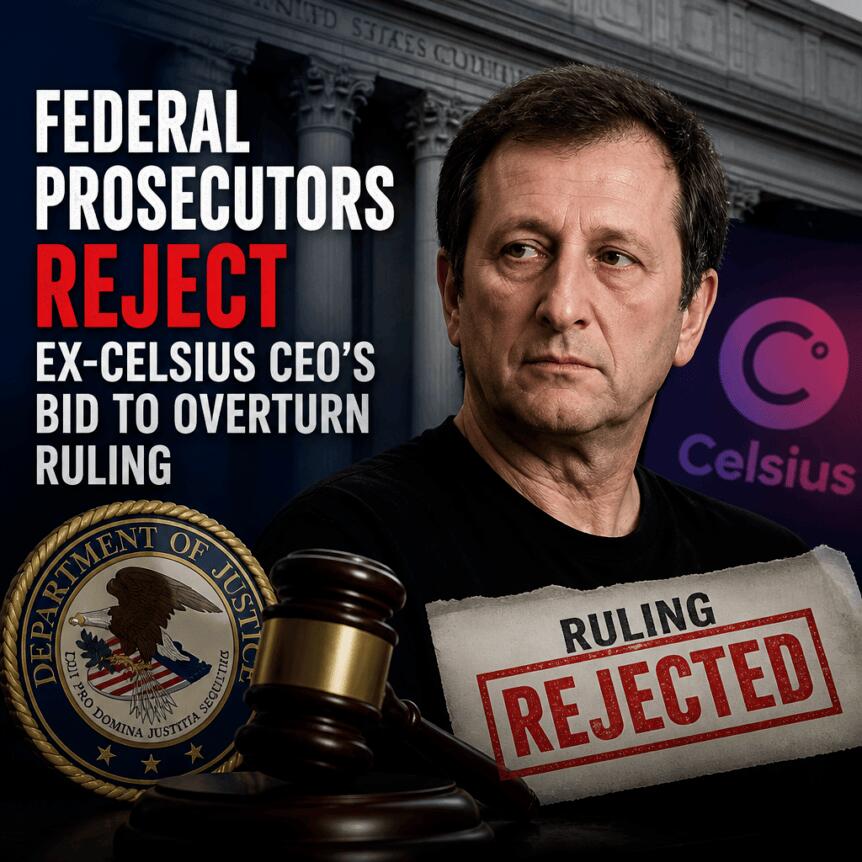 Prosecutors in the US Southern District of New York have urged a federal judge to reject Alex Mashinsky’s bid to overturn his 12-year fraud and market manipulation sentence tied to the collapse of Celsius. In a Friday filing, attorneys for the government argued that Mashinsky’s legal challenges lack merit and that he did not substantiate [...]
Prosecutors in the US Southern District of New York have urged a federal judge to reject Alex Mashinsky’s bid to overturn his 12-year fraud and market manipulation sentence tied to the collapse of Celsius. In a Friday filing, attorneys for the government argued that Mashinsky’s legal challenges lack merit and that he did not substantiate allegations with the kind of sworn evidence the court would require.
The request comes as Mashinsky pursues post-conviction relief after pleading guilty to commodities fraud and securities fraud involving “manipulative and deceptive devices” related to Celsius. The filing also addresses Mashinsky’s decision to represent himself, with prosecutors saying his motion largely repackages arguments raised at sentencing and blames his former attorneys for not pressing certain points.
Key takeaways
SDNY prosecutors asked the court to deny Mashinsky’s petition to vacate his conviction and sentence, calling several arguments “without merit.”
Prosecutors criticized the motion for lacking a sworn declaration supporting allegations, and said Mashinsky’s claims largely revisit the sentencing record.
Mashinsky was sentenced in May 2025 to 144 months in prison after a plea covering commodities and securities fraud connected to Celsius.
Meanwhile, the SEC civil case remains unresolved, with reported settlement discussions as of late July.
Separately, the CFTC permanently banned Mashinsky from trading in commodities markets under its jurisdiction in June.
Prosecutors move to block Mashinsky’s bid to vacate
According to the government’s filing, SDNY attorneys James McDonald and Allison Nichols argued that the court should deny Mashinsky’s petition. They specifically pushed back on claims that his prior legal counsel provided ineffective assistance, and they characterized Mashinsky’s overall approach as an unsustained effort to re-litigate issues already considered during sentencing.
Mashinsky informed the court in May that he would proceed pro se, meaning he would represent himself. His motion to vacate included references to the failure of cryptocurrency exchange FTX and to Roni Cohen-Pavon, a former Celsius executive who was the company’s chief revenue officer. Prosecutors said the court should not hold a hearing or conduct additional fact-finding because the allegations were not adequately supported.
In their response, prosecutors said Mashinsky “has not even submitted a sworn declaration” in support of the “baseless allegations,” arguing that the petition should be denied outright. They also described the filing as a “litany of complaints,” much of which allegedly focuses on blaming others for Celsius’s problems and rehashing evidence from sentencing.
What the government says is missing—and what it implies
A central theme in the prosecutors’ pushback is procedural and evidentiary. Prosecutors contended that Mashinsky’s motion does not provide sworn testimony or declarations backing up the claims he made. In post-conviction proceedings, that distinction matters: allegations—especially those implicating new facts or misconduct beyond the trial record—generally require more than argument.
Prosecutors also suggested that Mashinsky stopped short of asserting factual innocence. Instead, they argued, his petition centers on claims that his lawyers failed to pursue certain arguments. That matters because courts reviewing convictions and sentences after a guilty plea often take a narrower view of what can be revisited, particularly when the motion is framed around counsel’s performance rather than newly established exculpatory facts.
As of Tuesday, the judge overseeing the case had not responded to the filing.
Sentencing backdrop: guilty plea, prison term, and related outcomes
Mashinsky was sentenced in May 2025 to 144 months in prison. The plea covered commodities fraud and securities fraud, with the underlying conduct described by the court as involving “manipulative and deceptive devices” connected to Celsius. The government’s response ties the current motion to that sentencing foundation, saying Mashinsky largely recycles the record.
Cohen-Pavon, who prosecutors said provided “substantial assistance” to the government’s case against Mashinsky, was sentenced to time served in May. This pairing underscores how prosecutors presented cooperation as a factor in the differing outcomes following guilty pleas.
Beyond the criminal case, authorities also pursued monetary and civil consequences. At sentencing, Mashinsky was ordered to pay $48 million in forfeiture. In a separate matter, he also agreed to pay $10 million as part of a settlement with the US Federal Trade Commission.
Regulatory developments after Celsius’ collapse
Celsius’ downfall in 2022 triggered multiple investigations and proceedings. After the company filed for bankruptcy during a broader market downturn, authorities indicted Mashinsky and Cohen-Pavon in 2023, and both later pleaded guilty.
On the regulatory side, the CFTC announced in June that Mashinsky was permanently banned from trading in markets within the regulator’s purview. Prosecutors’ current opposition to a sentence-vacatur petition comes after this additional restriction, reinforcing that regulators treated his conduct as disqualifying even beyond the criminal sentencing.
At the same time, the SEC civil case has continued to move more slowly. According to the SEC report dated July 30, the regulator and Mashinsky were “engaged in settlement discussions.” The SEC asked the court for 60 days to submit a status report, effectively pushing the next major procedural step to around the end of September. That creates a parallel track: criminal punishment is finalizing, while civil resolution appears to be in negotiation.
Readers should note that the CFTC matter was described as one of the last remaining cases tied to Mashinsky and Celsius after the bankruptcy, while the SEC litigation persisted despite earlier developments in the court system.
What happens next in court
The immediate question is whether the judge grants any further review or hearing in response to Mashinsky’s self-filed petition. Given the prosecutors’ arguments—particularly the lack of sworn declarations and the claim that many issues have already been addressed—Mashinsky’s next opportunity will likely depend on whether the court views his submissions as procedurally sufficient to proceed.
Separately, the unresolved SEC civil case will be another key watch point, especially as settlement discussions continue into the reported status-report timeline. Together, these tracks will determine how quickly Mashinsky’s legal exposure is fully resolved across both criminal and regulatory frameworks.
This article was originally published as Federal Prosecutors Reject Ex‑Celsius CEO’s Bid to Overturn Ruling on Crypto Breaking News – your trusted source for crypto news, Bitcoin news, and blockchain updates.
About the Author


