South Korea Regulators Draft Tokenized Securities Roadmap
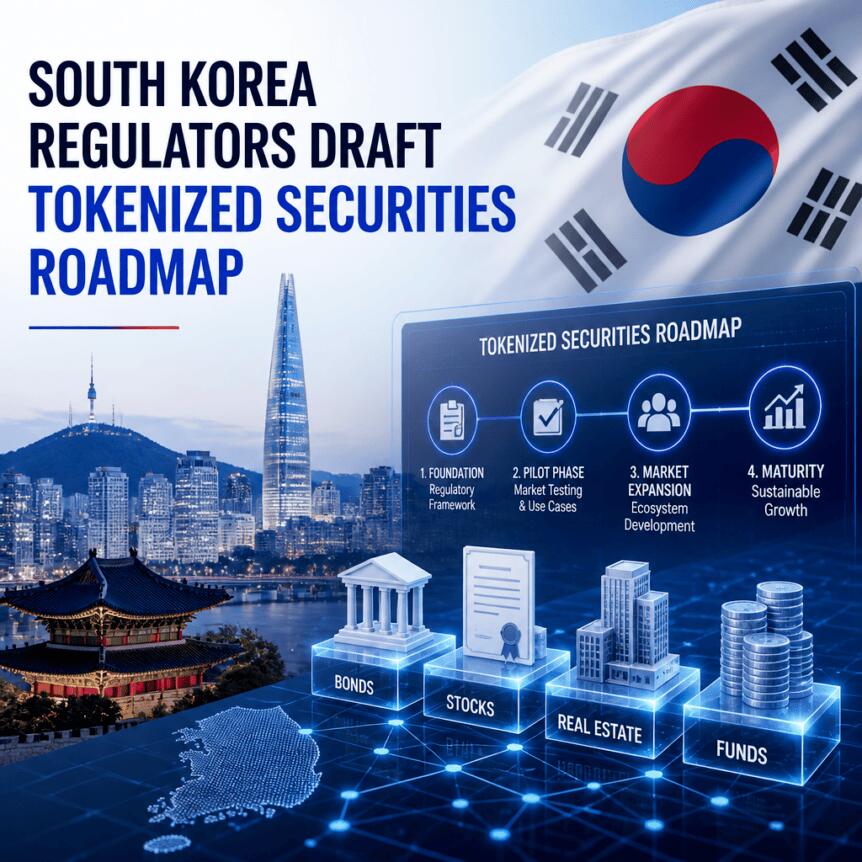 South Korea’s Financial Services Commission (FSC) has laid out a three-phase plan to build the legal and technical groundwork for issuing tokenized securities—an effort that, if executed on schedule, would clarify how onchain securities could fit within the country’s existing capital markets framework. In a press release issued Friday, the FSC said tokenized securities are [...]
South Korea’s Financial Services Commission (FSC) has laid out a three-phase plan to build the legal and technical groundwork for issuing tokenized securities—an effort that, if executed on schedule, would clarify how onchain securities could fit within the country’s existing capital markets framework.
In a press release issued Friday, the FSC said tokenized securities are expected to gain formal legal recognition starting Feb. 4, 2027, following an update to the Act on Electronic Registration of Stocks and Bonds. The initiative also points toward a later phase connecting tokenized issuance and payments with stablecoins.
Key takeaways
The FSC plans to recognize tokenized securities legally from Feb. 4, 2027 via amendments to the Act on Electronic Registration of Stocks and Bonds.
Phase one covers legal recognition for tokenized versions of selected instruments, including certain funds and bonds, along with unlisted stocks and fractional investment securities.
Phase two would broaden tokenization to apply to all publicly offered securities.
Phase three targets onchain payment flows linked to stablecoins, indicating regulators see stablecoins as part of the settlement picture.
Before launching the roadmap, the FSC intends to collaborate with the Korea Securities Depository (KSD) on the necessary tokenization infrastructure.
A date-specific shift toward legal recognition
Until now, tokenized securities have faced regulatory uncertainty in many jurisdictions—typically tied to questions about legal status, transfer mechanisms, and settlement. South Korea’s plan attempts to remove at least one major friction point by tying recognition of tokenized securities to a concrete legislative timetable.
The FSC said that beginning Feb. 4, 2027, tokenized securities would be recognized as digitized forms of securities after the scheduled update to the Act on Electronic Registration of Stocks and Bonds takes effect. This is intended to align the tokenized form with the legal infrastructure already used for registering and handling stocks and bonds electronically.
The roadmap is described as part of the implementation of amended versions of the Capital Markets Act and the Electronic Securities Act, which the FSC framed as the country’s first tokenized securities framework.
What the three phases cover
The FSC’s approach is staged, moving from recognition of specific instruments to broader application and then toward a more integrated onchain settlement model.
Phase one focuses on bringing tokenized securities into the regulatory and legal fold for a limited set of products. According to the FSC, legal recognition would apply to tokenized securities that include:
institutional money market funds
bonds
unlisted stocks
fractional investment securities
Phase two would expand tokenization to all publicly offered securities. For market participants, this sequencing matters: it suggests that issuers and intermediaries will be expected to adapt operational and compliance processes first for a controlled set of instruments, before the rulebook potentially broadens to cover a wider universe of public offerings.
Phase three is the most ambitious and forward-looking. The FSC said it aims to enable onchain payments connected to stablecoins. While the announcement stops short of detailing technical standards or regulatory limits for stablecoins in this context, the fact that stablecoin-linked payments are included in the final phase indicates regulators are thinking beyond token issuance alone and toward settlement and custody-to-payment workflows.
Rulemaking steps and the role of market infrastructure
Alongside the legislative timeline, the FSC laid out additional near-term administrative work. It said it plans to propose revisions to relevant subordinate regulations by the end of September—a step that typically determines how the law will function in practice, including the operational rules that govern issuance, transfer, and compliance.
Importantly, the FSC also indicated it would decide the timetable for phase two and phase three after the subordinate revisions are prepared, meaning that the later phases are not fully locked in by the Feb. 4, 2027 recognition date.
Before the roadmap begins, the FSC said it would work with the Korea Securities Depository (KSD) to develop the tokenization infrastructure required for the framework. For investors and firms, that matters because successful tokenization depends heavily on the readiness of core market plumbing—interfaces with registries, confirmation of ownership records, and the ability to reconcile onchain activity with established capital markets processes.
Why the roadmap signals a tightening regulatory stance
This announcement comes as South Korean regulators have been steadily moving closer to a defined regime for tokenized assets. Earlier, the FSC had indicated that it would publish detailed tokenized securities rules to bring them under the country’s capital markets framework in 2027, according to reporting on the FSC’s prior stance.
In addition, South Korea has been experimenting with tokenized settlement concepts outside of securities issuance. In April, the Ministry of Economy and Finance announced a pilot project using tokenized deposits for executing government operational spending, with a full rollout planned for the fourth quarter of 2026. That effort is separate from the FSC’s tokenized securities framework, but it reinforces the broader regulatory direction: using tokenization not only for trading or issuance, but potentially for real-world payments and operational transfers.
Viewed together, the FSC’s roadmap suggests South Korea is trying to reconcile two priorities that often clash in tokenization discussions: preserving the legal certainty of traditional capital markets while making room for blockchain-based representation and, eventually, onchain payment rails.
At the same time, the phased nature of the plan leaves practical questions open. The biggest uncertainty for market participants is likely how quickly phase two and phase three will move after the subordinate regulations are drafted, and what technical and compliance requirements will accompany stablecoin-linked onchain payments.
For readers watching this space, the next signals to track are the FSC’s subordinate regulation revisions due by the end of September and the details that emerge from its coordination with the KSD—especially anything clarifying how settlement, custody records, and stablecoin-linked payment flows will be handled under the updated legal framework.
This article was originally published as South Korea Regulators Draft Tokenized Securities Roadmap on Crypto Breaking News – your trusted source for crypto news, Bitcoin news, and blockchain updates.
About the Author


