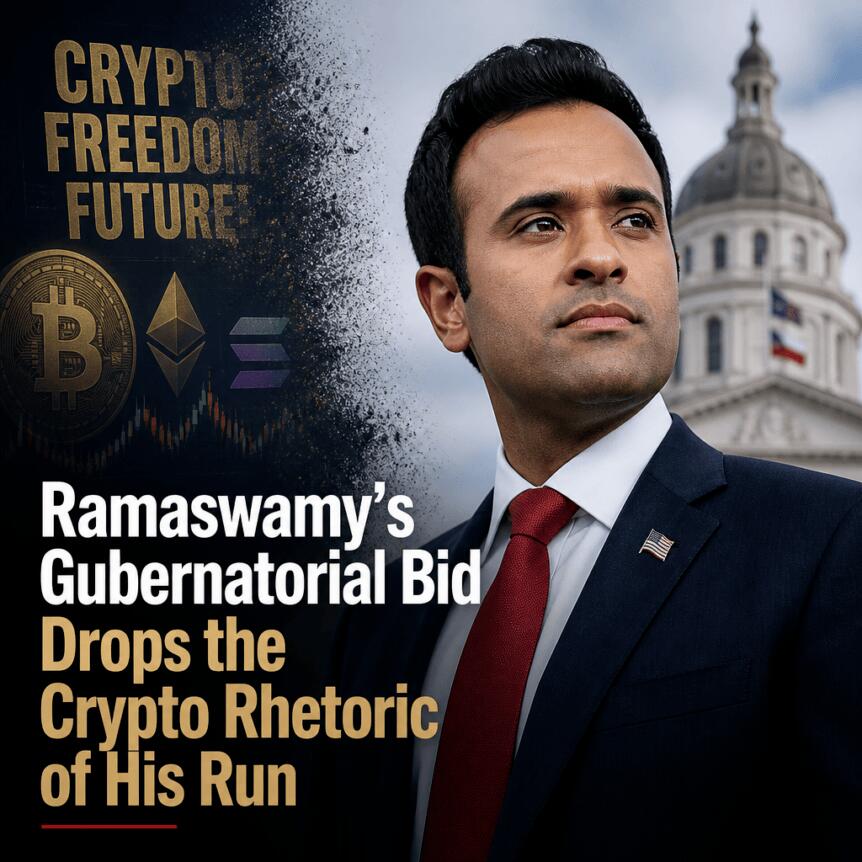
Ramaswamy’s Gubernatorial Bid Drops the Crypto Rhetoric of His Run
 Vivek Ramaswamy’s political relationship with crypto has long been familiar to American voters: during his 2024 presidential bid, he frequently promoted Bitcoin and criticized central bank digital currencies, while pitching mining and industry-friendly themes on the campaign trail. Now, as Ramaswamy runs for Ohio governor, his stance on digital assets remains visible—but the day-to-day messaging [...]
Vivek Ramaswamy’s political relationship with crypto has long been familiar to American voters: during his 2024 presidential bid, he frequently promoted Bitcoin and criticized central bank digital currencies, while pitching mining and industry-friendly themes on the campaign trail. Now, as Ramaswamy runs for Ohio governor, his stance on digital assets remains visible—but the day-to-day messaging around it appears less prominent than it was in the White House race.
The shift matters because Ohio has become a battleground where pro-crypto political efforts and public skepticism meet. In parallel, campaigns over how communities should deal with large data centers—often tied to power-hungry crypto mining—have added another layer of political friction for both parties.
Key takeaways
Ramaswamy’s earlier presidential campaign leaned heavily on crypto themes, but recent messaging around digital assets appears toned down entering the Ohio race.
His campaign still engages with crypto directly, including accepting campaign donations in digital assets.
Ramaswamy-backed crypto policy signals continue, including support for an Ohio bill to enable a strategic Bitcoin reserve.
Ohio voters have shown comparatively more negative views on crypto in earlier polling, while data centers have become a controversial election issue.
Electoral dynamics in Ohio—along with heavy industry-linked spending seen in recent cycles—suggest crypto is part of the political calculus even when it’s not always the headline.
From presidential stump to Ohio ballot
During his attempt to win the Republican nomination for president in 2024, Ramaswamy made crypto a regular theme. He repeatedly opposed central bank digital currencies, praised Bitcoin and mining, and even appeared as a keynote speaker at industry events. After Donald Trump won the election, Ramaswamy was tapped to lead the Department of Government Efficiency (DOGE) alongside Elon Musk, though he left before being formally part of the administration.
When he moved his attention to Ohio, he did not fully retreat from crypto—he continued to post in support of state-level digital asset initiatives. Ahead of his February 2025 run for governor, he publicly supported the Ohio Strategic Cryptocurrency Reserve Act, a state bill that would allow the creation of a strategic Bitcoin reserve.
At the same time, the tone differs from his presidential phase. According to Cointelegraph’s reporting, by September 2026—weeks before the election—Ramaswamy’s public statements on digital assets and related policies had “waned” compared with the rhetoric of 2024 and 2025.
Investment exposure, industry ties, and campaign funding
Ramaswamy’s campaign remains intertwined with crypto in ways that go beyond slogans. His campaign website accepts donations in cryptocurrency, and the candidate has drawn financial support from figures connected to World Liberty Financial, a crypto company associated with the Trump family. The article notes that three co-founders—Chase Herro, Zak Folkman, and Zachary Witkoff—each donated the maximum allowable amount of $16,615.
Beyond individual donations, industry-linked groups have also poured money into Ramaswamy’s Super PAC, “V-PAC: Victors, Not Victims.” Cointelegraph cites filings showing donations from major crypto-associated backers, including $20 million from Susquehanna International Group co-founder Jeff Yass, $6 million from NYDIG founder Ross Stevens, and $5 million from Elon Musk, along with additional contributions such as $5,000 from the Bitcoin Voter Project. The reporting attributes these numbers to campaign finance records.
Ramaswamy has also maintained a stake in Strive, an asset manager he co-founded in 2022. According to the source, Strive reported holding 23,156 BTC valued at about $2 billion as of Aug. 28, and an August filing with the U.S. Securities and Exchange Commission stated that Ramaswamy owned 5,693,897 shares in the company, worth more than $170 million as of Sept. 26. The reporting further states he personally reported holding more than $1,000 in BTC and Ether as of April through a Coinbase wallet, based on an Ohio disclosure document hosted by Signal Ohio.
Ohio’s voters: crypto skepticism and the data-center backlash
Part of the reason crypto may be less central in Ramaswamy’s current messaging could be how the electorate is reacting to digital-asset-related infrastructure. Ohio has shown signs of skepticism toward crypto compared with other states. Cointelegraph points to a May 2024 poll conducted by the Digital Currency Group, which suggested Ohio respondents were “more negative towards crypto”: 79% said they had never held crypto, and 77% reported negative views.
In the 2026 campaign environment, the political controversy is not just about the assets themselves, but also about the physical expansion that surrounds them. Data centers have become a flashpoint for Ohio politics. The article cites Pew Research Center data indicating that, as of April, Ohio had 166 data centers—more than any other state. It also notes that Ohio is home to crypto mining operations including Cipher Mining, Bitdeer, and BIT Mining.
Cointelegraph also highlights polling showing that many Ohio residents oppose data centers in their communities. Ramaswamy, according to the report, pledged in August that any data center built in Ohio communities would result in no electricity cost for residents and lower property taxes. His Democratic opponent, Amy Acton, proposed that costs for gas, water, and electricity needed for data centers should be covered by data centers and their investors rather than Ohio taxpayers or communities.
Why the timing looks different in 2026
Crypto is still present in Ohio politics, even if it is not always the central talking point. The state has been a target for political spending connected to the industry. Cointelegraph notes that more than $40 million was spent by industry-aligned groups in 2024 to help support Republican Bernie Moreno’s Senate run. Following Moreno’s victory over incumbent Democrat Sherrod Brown, Brown is now back on the ballot—this time running against Republican Jon Husted—and crypto-linked groups are again positioning for the contest. Cointelegraph cites reporting that Fairshake pledged to initially spend $30 million opposing the Democrat and that it had already reported $11 million in ad buys.
Market-style election odds tracked via event contracts and polling add to the sense that Ohio is tightly contested. Cointelegraph cites RealClearPolling, indicating that as of Sept. 22 Acton held a one-point lead. It also references Kalshi event-market contracts at the time of publication, reporting more than $2 million in bets and odds that favored Acton with a 66% chance, alongside similar odds on Polymarket.
Meanwhile, the source notes a potential contrast between Ramaswamy’s earlier crypto-heavy rhetoric and his later political posture. In September 2026, it reports that the Ohio Secretary of State announced acceptance of cryptocurrency to pay for state fees and services, and that Ramaswamy had not addressed that notice as of publication—underscoring how crypto debates in Ohio are increasingly entangled with state policy implementation rather than campaign branding alone.
As the Ohio governor’s race tightens, watch whether Ramaswamy returns to more direct crypto-policy messaging—or instead keeps shifting toward tangible infrastructure questions like data centers and local costs that may be driving voter sentiment. The next few weeks of statements and debates should clarify whether crypto remains a governing agenda item or becomes more of a background issue in a contest shaped by community impact.
This article was originally published as Ramaswamy’s Gubernatorial Bid Drops the Crypto Rhetoric of His Run on Crypto Breaking News – your trusted source for crypto news, Bitcoin news, and blockchain updates.
About the Author


