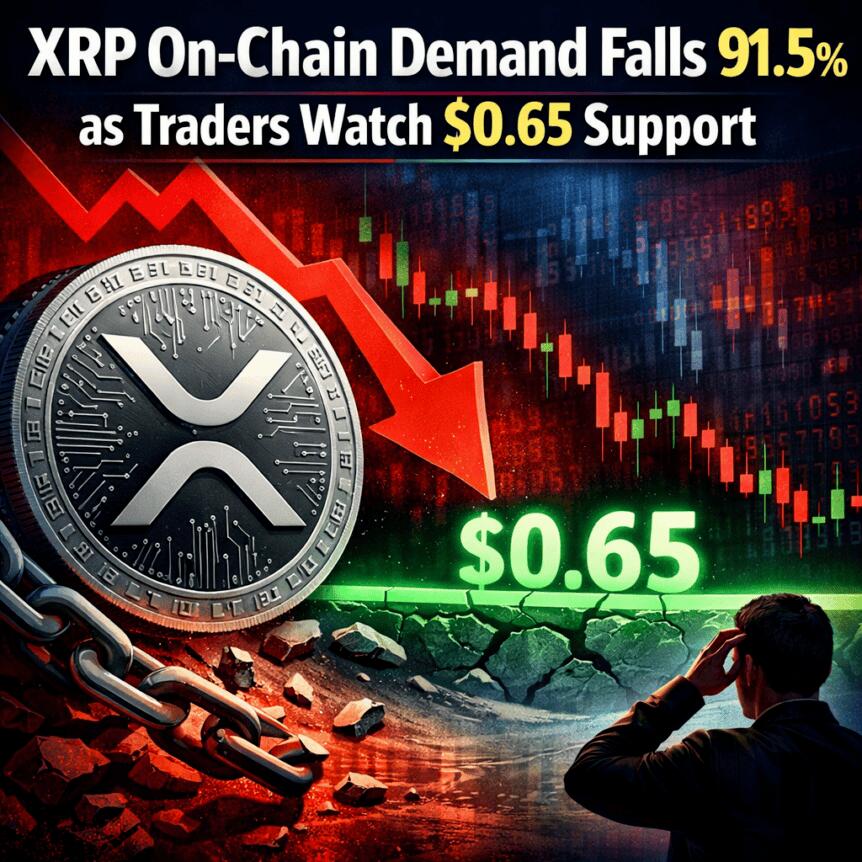
XRP On-Chain Demand Falls 91.5% as Traders Watch $0.65 Support
 XRP’s on-chain activity has cooled dramatically since its 2025 surge, according to Glassnode’s latest on-chain metrics. The 90-day average of total XRP network fees has plunged to about 500 XRP from roughly 5,900 XRP in February, a 91.5% drop that points to a sharp slowdown in on-chain demand after the mid-2025 price spike that briefly [...]
XRP’s on-chain activity has cooled dramatically since its 2025 surge, according to Glassnode’s latest on-chain metrics. The 90-day average of total XRP network fees has plunged to about 500 XRP from roughly 5,900 XRP in February, a 91.5% drop that points to a sharp slowdown in on-chain demand after the mid-2025 price spike that briefly pushed XRP above $3. The pullback in on-chain activity mirrors a broader shift in trader behavior and market structure after a period of intense speculation.
Compounding the view of a cooling market, XRP’s 90-day realized profit-to-loss ratio has collapsed to 0.38, suggesting that more coins are being realized at losses than profits on-chain. At the height of its price run in January and July 2025, when XRP traded near $3.40, the ratio reached around 50 as profit-taking dominated flows. The current regime, by contrast, signals a possible capitulation environment where selling pressure is less about wholesale distribution by big holders and more about risk-off sentiment and leverage-driven liquidations.
Key takeaways
On-chain demand for XRP has slumped sharply since the 2025 rally, with the 90-day average of network fees falling 91.5% to around 500 XRP.
The 90-day realized profit-to-loss ratio has fallen to 0.38, indicating losses are being realized more than profits as investors exit positions.
Exchange-related activity shows a cooling dynamic: large XRP transfers to centralized venues like Binance have declined since the 2025 peak, hinting at a shift away from mass whale distribution.
A defined accumulation zone between roughly $1.00 and $0.65 is taking shape, anchored by technical levels such as a fair value gap and a high-volume node around $0.50–$0.65.
Despite near-term weakness, a subset of analysts maintains a longer-term bullish thesis, with a target range of about $15–$18, underscoring the ongoing debate over XRP’s eventual fundamental trajectory.
On-chain activity and what it signals
Glassnode’s analysis stresses that XRP’s on-chain activity has cooled substantially after the explosive run that pushed the token above $3 in the first half of 2025. The drastic drop in the 90-day fee average—from thousands of XRP to a few hundred—suggests a cooling in the network’s transaction activity and a retrenchment of speculative demand. In practical terms, the fee data are often treated as a proxy for everyday transactional use on the XRP ledger, and the current readings imply a lull in users and a normalization after a period of exuberant activity.
Observers are watching whether this cooling translates into a more stable or even depressed price regime. The price action that followed the mid-2025 spike created a technical environment where traders now see a broad band between $1.00 and $0.65 as a critical zone. The question is whether buyers will accumulate enough demand to defend that range or if the market will test lower levels in a broader risk-off cycle.
Profit dynamics: from profit-taking to capitulation?
The realized profit-to-loss ratio offers a window into how investors are managing their XRP positions as market conditions shift. The ratio’s plunge to 0.38 means that for every $1 of realized profit, approximately $2.63 of losses have been realized, a pattern often observed when a market moves from a distribution phase into capitulation, albeit without the same intensity of selling by large holders as in prior cycles.
For context, the ratio reached about 50 during the weeks when XRP hovered near $3.40 in 2025, indicating heavy profit-taking at those price points. The reversal to a low ratio is consistent with a broader shift away from aggressive on-chain profit-taking and toward a more cautious posture among market participants. While this doesn’t preclude a return to stronger hands pushing prices higher, it does highlight a renewed emphasis on risk controls and stop-out dynamics in a market that has already experienced substantial speculative fervor.
Whale flows, exchanges, and the bigger picture
On the exchange-front, data from CryptoQuant offers a complementary view to Glassnode’s on-chain activity. Analysts have flagged a decline in transfers of XRP to major exchanges, particularly among the higher-cohort holders. Notably, inflows of 100,000–1,000,000 XRP and those above 1,000,000 XRP have weakened since the 2025 peak, with declines of about 15% and 20%, respectively, since October 2025. The trend points to a reduction in the step-like distribution that often accompanies top-of-cycle sell-offs.
Analysts caution that the near-term price weakness appears more connected to leverage-driven liquidations and a risk-off mindset than to a broad, coordinated dump by large holders. In other words, while large holders are still active participants in the space, their activity does not appear to be the dominant force shaping XRP’s price action at this juncture. The combination of fading on-chain demand and shifting exchange dynamics creates a nuanced backdrop for traders who must weigh potential liquidity gaps against the possibility of renewed demand in a broader crypto-market upcycle.
In terms of regional and behavioral signals, the XRP ecosystem still shows a classic pattern: from a few clear acceleration points to a more cautious phase where traders hunt for lower-risk entries. CryptoQuant’s analysis highlights how inflows to exchanges from large holders have cooled, which historically has preceded or accompanied broader corrections in the XRP market. Yet, as ever in volatile crypto markets, these trends must be contextualized within macro conditions, liquidity cycles, and evolving regulatory dynamics that continue to shape investor risk appetite.
Technical map: where buyers are watching
From a chart perspective, XRP has been consolidating within a zone that many traders view as a potential bottoming region. The weekly price action points to a cluster of technical levels between $1.00 and $0.65. A notable fair value gap created during XRP’s late-2024 rally spans roughly $0.63 to $1.00, and price has shown movement back toward this zone after breaching the $1.40 level on the downside. Visible-range volume profile data indicate relatively light activity below current prices until a high-volume node sits around $0.50–$0.65, suggesting a meaningful area of liquidity in that neighborhood.
The point of control—the price area with the most traded volume—sits near $0.52–$0.55, reinforcing the idea that this range has become a magnet for immediate supply and demand. In addition, XRP’s five-year ascending trendline projects to intersect near $0.60–$0.65 in the coming months, a confluence of support that could anchor a potential bounce if macro conditions support renewed risk appetite.
On the community front, market observers have begun highlighting the $0.60–$0.65 band as a practical accumulation zone. Traders such as Crypto Patel have identified $1.00–$0.60 as a preferred range to accumulate, while others like Javon Marks continue to model a longer-term bull scenario with a target of roughly $15–$18 per XRP—a move that would imply roughly 1,100% upside from current levels. While such a trajectory remains contingent on a sustainable macro and market-driven re-pricing of risk, the convergence of on-chain, exchange, and technical signals keeps the narrative alive for those investors betting on a reacceleration in XRP’s adoption and liquidity cycle.
What to watch next
As the market digests a quieter on-chain environment and a shift in exchange activity, XRP traders will be closely watching whether demand can re-emerge around key support around $0.60–$0.65 and whether buying interest can sustain a move back toward the $1.00 threshold and beyond. The overarching question remains whether the longer-term bull thesis can absorb another round of macro shocks or if a fresh catalyst—regulatory clarity, improved liquidity conditions, or institutional participation—could reframe XRP’s trajectory in 2026.
This article was originally published as XRP On-Chain Demand Falls 91.5% as Traders Watch $0.65 Support on Crypto Breaking News – your trusted source for crypto news, Bitcoin news, and blockchain updates.
About the Author