Talos Integrates Institutional Trading Tools into Kalshi Markets
 Talos, an institutional crypto trading platform, has integrated with Kalshi so that select clients can trade Kalshi’s event contracts and crypto perpetuals through the same infrastructure. The goal is to remove the need for a separate technical connection when firms want regulated prediction market exposure alongside their existing digital asset workflows. The integration also adds [...]
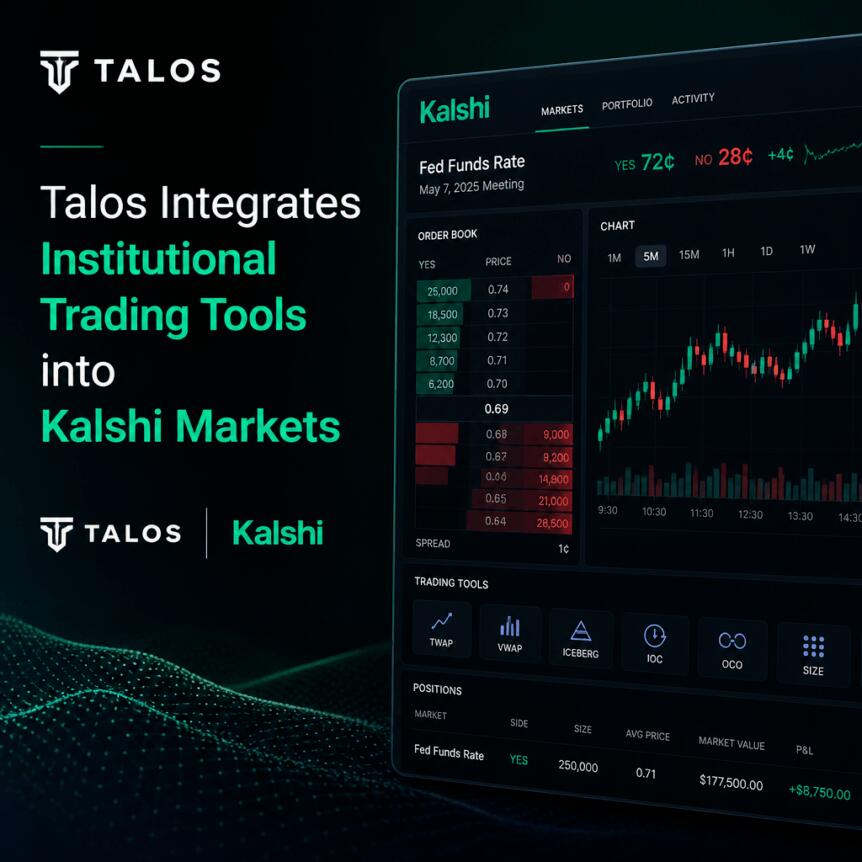
Talos, an institutional crypto trading platform, has integrated with Kalshi so that select clients can trade Kalshi’s event contracts and crypto perpetuals through the same infrastructure. The goal is to remove the need for a separate technical connection when firms want regulated prediction market exposure alongside their existing digital asset workflows.
The integration also adds institutional trading functionality, including algorithmic order types such as Iceberg, TWAP and POV, plus multi-leg execution for perp-to-perp and perp-to-spot spread strategies. Talos said it will support block trades in Kalshi contracts via its request-for-quote (RFQ) system, using participating over-the-counter liquidity providers.
Key takeaways
Single connection for multiple products: Talos clients can trade Kalshi event contracts alongside crypto perpetuals without switching platforms.
Institution-grade execution: The integration supports algorithmic orders (Iceberg, TWAP, POV) and multi-leg spread execution.
RFQ block trading for contracts: Kalshi contract blocks can be executed through Talos’ RFQ flow with OTC liquidity providers.
Planned broader distribution: Later this year, Talos intends to extend dealer software so brokers and other platforms can offer Kalshi contracts where permitted.
Standardized prediction market data in the works: Talos plans a unified data feed to normalize events, order books, open interest and implied probabilities across venues.
Why Talos is pulling Kalshi into its institutional stack
For professional traders and market participants, friction between trading venues can be just as important as liquidity itself. By embedding Kalshi access inside Talos’ existing crypto trading infrastructure, the company is effectively reducing operational overhead for firms that already run execution, risk and connectivity through Talos for digital assets.
Talos’ stated approach focuses on execution capabilities: algorithmic order types and multi-leg handling for both crypto perpetual pairs and combinations of perpetuals and spot. For market makers and hedge funds, those features matter because spreads and execution quality can drive outcomes as much as the underlying market.
In addition, Talos’ plan to route block trades in Kalshi contracts through its RFQ platform gives institutions another mechanism for size execution, potentially improving how large orders are filled in less transparent trading environments—though actual availability and terms depend on the participating liquidity providers.
Distribution upgrades planned: from dealer software to a unified data feed
Talos says that later this year it will extend its dealer software to brokers and other trading platforms. If markets and jurisdictions allow, that would enable intermediaries to offer Kalshi event contracts directly to their customers while keeping the same execution framework they already use for crypto assets.
The company also outlined a separate effort: a unified prediction market data feed designed to standardize key market elements—events, trades, order books, open interest and implied probabilities—across venues. In practice, a normalized feed can help firms compare markets more easily and build consistent analytics, especially when prediction market venues differ in how they structure contracts or present pricing data.
Both initiatives point toward a broader strategy: not just connecting one operator to one platform, but making prediction market infrastructure easier to integrate into professional trading ecosystems.
Prediction markets surge as institutions begin to take a larger role
The Talos-Kalshi integration lands during a period of rapidly expanding prediction market activity. CoinGecko’s 2026 Q2 crypto report, cited in the coverage, shows that total notional trading volume on prediction markets reached $113.8 billion in the second quarter, up 48.7% quarter-over-quarter. The report also notes that June alone hit $52.8 billion in notional volume, which it described as a new monthly record.
CoinGecko attributed the spike to a heavy sports calendar, including major global events such as the UEFA Champions League final, NBA Finals, Stanley Cup, FIFA World Cup and Wimbledon. It also highlighted that sports-related contracts dominated activity: on Polymarket, sports accounted for 81% of June trading volume, compared with 40% in January.
Market share data presented alongside the growth reinforces Kalshi’s momentum. According to the same CoinGecko report, Kalshi increased its share to 58.9% from 42.4% in the first quarter, while Polymarket’s share declined to 30.2% from 35.8%. The venture backed by Robinhood and Susquehanna International Group-backed interests—Rothera—ranked fourth by June, with $2.1 billion in notional trading volume after launching in May.
Growth continues, but legal and market-integrity risks remain
Even with rising activity, prediction markets are still contending with uncertainty in the United States and heightened attention from regulators and market participants. Coverage notes that Kalshi is involved in disputes with state regulators regarding whether its sports event contracts could be considered illegal gambling—an issue observers expect could eventually reach the US Supreme Court, according to earlier reporting on Cointelegraph.
Beyond the regulatory backdrop, scrutiny has also focused on market integrity. The coverage references earlier reporting that six Polymarket traders reportedly profited by about $1 million from bets on US military strikes against Iran before the attacks became public. Separately, it mentions that a White House teleprompter operator was placed on unpaid leave after allegedly betting more than $100,000 on Kalshi markets tied to President Donald Trump’s speeches.
For investors and trading firms watching the segment, these developments underscore a core tension: prediction markets are drawing more mainstream participation and institutional attention, but the credibility and long-term expansion of the space depend heavily on how law and enforcement address both the product classification question and allegations of information misuse.
As Talos expands access and moves toward standardized prediction market data, market observers will likely focus on two things: whether distribution through brokers broadens participation without running into additional compliance complexity, and how ongoing legal outcomes and integrity enforcement shape institutional willingness to scale exposure in the months ahead.
This article was originally published as Talos Integrates Institutional Trading Tools into Kalshi Markets on Crypto Breaking News – your trusted source for crypto news, Bitcoin news, and blockchain updates.
About the Author


