Ripple Backs Zilo and Licuido to Accelerate Tokenized Markets
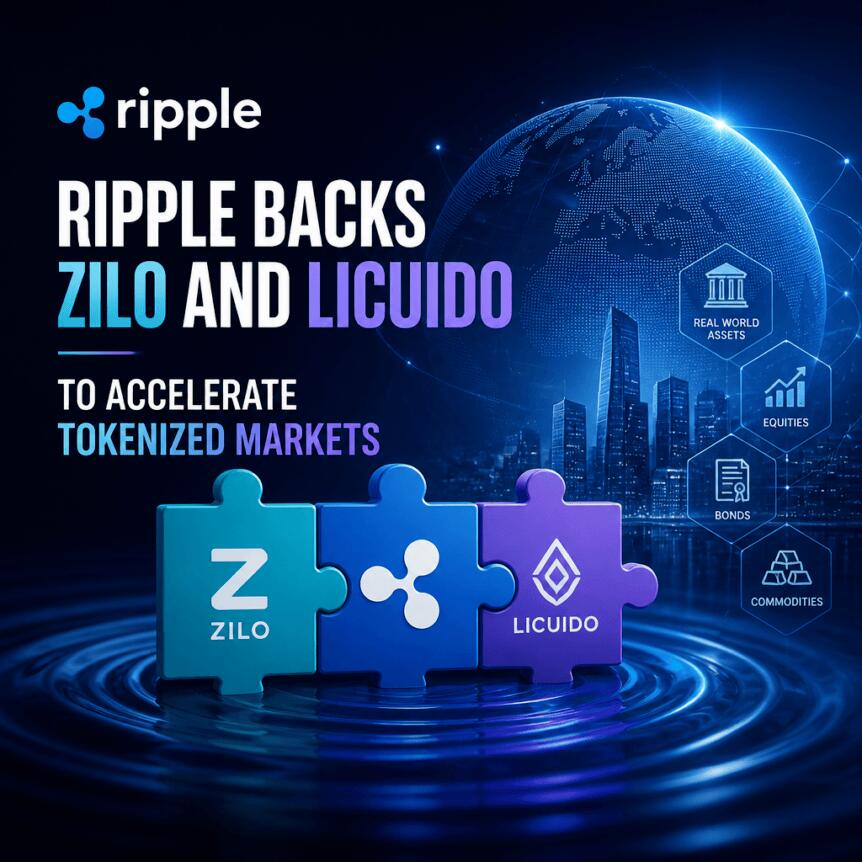 Ripple has announced two strategic investments aimed at expanding how regulated tokenized financial assets move across its XRP Ledger (XRPL). The company says the deals are intended to improve “collateral mobility” for tokenized funds—an issue that has become increasingly relevant as institutions look for more efficient ways to use on-chain assets within existing financial workflows. [...]
Ripple has announced two strategic investments aimed at expanding how regulated tokenized financial assets move across its XRP Ledger (XRPL). The company says the deals are intended to improve “collateral mobility” for tokenized funds—an issue that has become increasingly relevant as institutions look for more efficient ways to use on-chain assets within existing financial workflows.
In a Monday announcement, Ripple said it invested in Zilo, a global transfer agency asset solutions provider for wealth managers, and in Licuido, a tokenization solutions company regulated by the UK Financial Conduct Authority. Financial terms were not disclosed.
Key takeaways
Ripple’s new investments target the infrastructure around tokenized asset lifecycle events—transfer agency, issuance, and collateral usage—on XRPL.
Zilo is a UK-based transfer agency solutions provider for wealth managers; Licuido is a UK tokenization firm regulated by the FCA.
Ripple did not disclose investment amounts, leaving investors to assess impact based on the strategic integration of these partners into XRPL-based services.
The announcement arrives amid rising tokenized real-world assets activity, including new XRPL-based launches approved by regulators.
Why transfer agency and tokenization infrastructure matter
Tokenized real-world assets (RWAs) depend on more than issuance and settlement technology. For institutional participation, the operational stack must also support regulated lifecycle components such as transfer agency, issuance processes, and how assets (or their representations) can be pledged or reused as collateral.
Ripple’s stated goal is to bring “regulated transfer agency, issuance, and collateral mobility” into XRPL infrastructure. According to the company, the combination of the two investments is designed to address friction related to idle collateral by enabling tokenized funds to be used as collateral from the point of issuance.
While stablecoins and on-chain settlement get much of the attention, this kind of infrastructure push speaks to a broader theme in RWAs: institutions often need familiar controls, governance, and operational guarantees that mirror traditional market plumbing—only faster, more programmable, and easier to interoperate across counterparties.
Zilo and Licuido: what Ripple says it is buying into
The Zilo investment focuses on transfer agency capabilities for wealth managers. Ripple described Zilo as providing global transfer agency asset solutions, a function that can include administrative and compliance-heavy tasks tied to holding, transferring, and servicing investment products.
For market participants, transfer agency is especially significant because it determines how ownership records are managed, how subscriptions or redemptions are handled, and how compliance and reporting obligations are met. Bringing that layer closer to tokenized issuance and ongoing asset movement can reduce operational handoffs—often one of the major barriers for scaling tokenized offerings.
Licuido, by contrast, is positioned as a tokenization solutions provider that operates in a regulated environment. Ripple highlighted that Licuido is regulated by the UK Financial Conduct Authority, which could be relevant for firms aiming to structure tokenized products with compliance expectations baked into the system rather than added after the fact.
Neither investment’s size was disclosed by Ripple. However, the article notes that UK-based Zilo has raised $58.7 million in total equity funding, based on data compiled by Traxcn.
Momentum across XRPL as tokenized funds expand
Ripple’s move comes shortly after institutional activity on XRPL. Earlier, London-based asset manager Aviva Investors launched a tokenized share class of its US Dollar Liquidity Fund on XRPL, after receiving approval from the Central Bank of Ireland, according to earlier coverage. That development underscored that XRPL-based tokenization is not just a technical experiment—it is reaching regulated asset structures with supervisory sign-off.
The investments also follow Ripple’s own product push on the stablecoin side. Last month, Ripple launched Ripple Mint, a platform that gives institutions new ways to access, mint, redeem, and manage Ripple USD (RLUSD), its US dollar-pegged stablecoin. Together, these efforts indicate a two-pronged strategy: improve tokenized asset tooling around issuance and collateral use, while also expanding institutional access mechanisms for the stablecoin that often anchors value transfer.
At the network level, XRPL is part of a broader acceleration in tokenized RWAs. According to data from RWA.xyz referenced in the source, XRPL is the 11th-largest blockchain network by tokenized real-world assets, with $368 million in tokenized RWAs. Ethereum leads at $17.1 billion, per the same dataset.
Over the past 30 days, total RWA holders increased by 50% to 1.57 million, while total tokenized asset value rose by 1.5% to $37.3 billion. For investors, these figures suggest continued expansion, even as most networks compete on how efficiently they can support regulated asset workflows—not merely on-chain performance.
What to watch next for XRPL-based RWAs
Ripple’s latest announcements point to a practical focus: moving beyond token issuance to the operational lifecycle that institutions require, particularly where collateral reuse and collateral lock-ups can slow capital efficiency. The next question is how quickly these partner integrations translate into deployments—such as new tokenized funds, more standardized custody/transfer agency processes, or demonstrable reductions in collateral idling.
For market participants, attention should also be on whether future XRPL launches continue to follow regulator-approved paths and whether the tokenization stack expands toward wider categories of tokenized products—especially those that require complex transfer and compliance operations.
This article was originally published as Ripple Backs Zilo and Licuido to Accelerate Tokenized Markets on Crypto Breaking News – your trusted source for crypto news, Bitcoin news, and blockchain updates.
About the Author


